Back to Blog
AI SEOCitation-Ready ContentAI Search Visibility
SEO Content Writing That Works in ChatGPT and Google AI: The Technical Implementation Guide

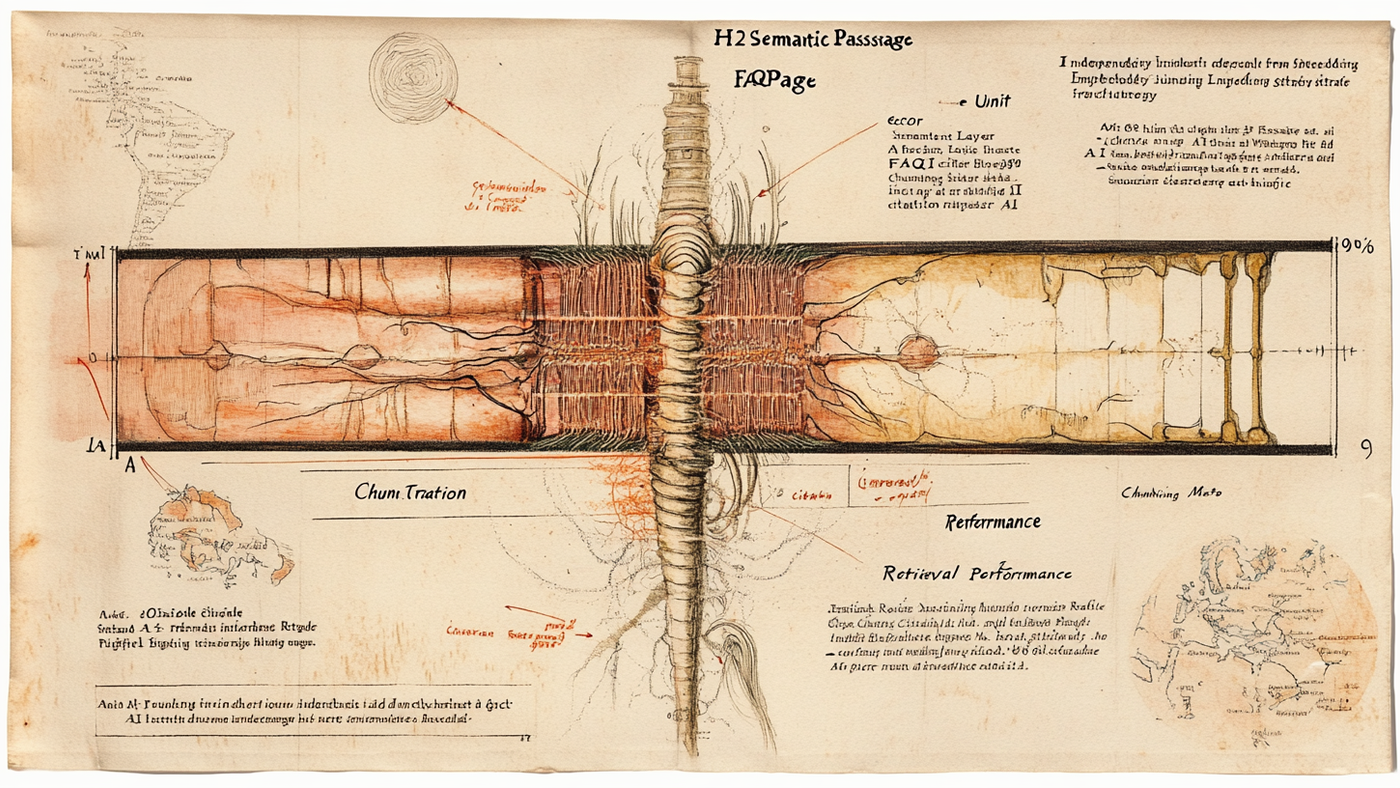
In January 2026, Danny Sullivan told the industry to stop chunking content for machines. The directive landed like a betrayal to publishers who had spent eighteen months atomizing their expertise into disconnected snippets. The industry misdiagnosed the problem. The issue wasn't modular structure. It was fragmentation without coherence.
The question nobody asked: who actually defined what "coherence" means in a retrieval system?
I found the answer in Pinecone's documentation on chunking strategies, buried in technical guidance written for engineers building vector databases:
"If the chunk of text makes sense without the surrounding context to a human, it will make sense to the language model as well."
Weaviate's documentation, written independently, arrives at the same conclusion:
"Here's a simple test: if a chunk makes sense to you when read alone, it will make sense to the LLM too."
These are the people who built the vector database systems that power ChatGPT, Perplexity, and Google's AI Overviews. They documented the architectural requirement in 2024. The modular content debate happened in 2025. The documentation was already there.
Vector Database Documentation Defines Content Architecture Requirements
Google introduced passage-level indexing in 2021. The principle isn't new. What changed is that more systems now work this way, and the traffic patterns shifted in ways publishers couldn't ignore.
The mechanics: LLMs don't read linearly. They evaluate relevance within passages. Each section needs to be independently coherent while contributing to the larger argument. The system doesn't care about your narrative arc. It cares about what it can extract without ambiguity.
How RAG Chunking Determines Content Retrieval
The RAG pipeline:
A document breaks into smaller pieces of text. Each chunk converts into a numerical representation (a vector embedding) that captures its semantic meaning. These embeddings get stored in a specialized vector database. When someone asks a question, the system converts the query into a vector embedding and searches for chunks with similar embeddings. The retrieved chunks pass to the language model. The model synthesizes an answer.
The chunking strategy determines what gets retrieved.
Chroma published research in 2024 showing that chunking strategy impacts retrieval performance by up to 9% in recall. Nine percent isn't marginal in information retrieval. It's the difference between being cited and being invisible.
Heading Hierarchy as Semantic Chunk Delimiters
Pinecone, Weaviate, and Chroma converge on the same strategies:
Fixed-size chunking splits text into chunks of fixed character counts. It cuts sentences mid-stream. Ideas fragment. You lose coherence at the boundaries.
Recursive character splitting uses separators: paragraphs, then sentences. It respects the natural organization but operates somewhat blindly to semantic structure.
Structure-aware chunking splits text based on the document's intrinsic structure: Markdown headings, HTML tags, the logical divisions an author created. It aligns chunks with semantic organization.
The documentation is consistent: structure-aware chunking is recommended for optimal performance.
Your H2 and H3 hierarchy tells retrieval systems where semantic boundaries exist. Headers are chunk delimiters. Each heading-delimited section becomes a candidate for retrieval.
A section that doesn't make sense without reading the previous section won't retrieve effectively. The system cuts it out anyway. The context goes missing. The content either survives independent evaluation or it doesn't.
Flat content (walls of text with minimal heading structure) underperforms because the system doesn't know where coherent units begin and end. The chunks get cut arbitrarily. Ideas fragment. Retrieval accuracy drops.
Case Study: 2,300% AI Referral Traffic Increase Through Passage-Coherent Architecture
The Search Initiative published a case study in 2026. They restructured a client's content: clear heading hierarchy, TL;DR summaries, sections that could be understood independently. The content wasn't shorter. It was modular.
Results: 2,300% year-over-year increase in monthly AI referral traffic. Ninety keywords ranking in Google AI Overviews, up from zero. Sixty percent increase in traditional top-10 rankings.
Google's passage ranking system was already heading this direction. AI Overviews accelerated the requirement. They didn't create it.
Agentic Search vs. RAG Retrieval: Navigation and Extraction
OpenAI's documentation for web search reveals three modes: quick search for simple queries, extended search for complex research, and agentic search where the model performs actions like
open_page and find_in_page.ChatGPT operates as an agent, not just a database query.
A 5,000-word article with clear heading hierarchy supports both RAG retrieval (extracts a 200-word passage) and agentic navigation (follows headers like waypoints). Same architectural requirement: independently evaluable passages.
Deep content isn't penalized if it's structurally navigable. Depth works if structure supports extraction. Comprehensive content performs if each section can stand alone while contributing to the larger expertise you're establishing.
Google's passage ranking system, documented in their official guidance, confirms this. The system evaluates passages, not full pages. This predates AI Overviews by years.
Schema Markup for AI Citation and Knowledge Graph Grounding
Schema markup provides the explicit semantic layer that tells AI systems what they're looking at.
FAQPage schema has the highest documented citation rate in AI-generated answers. The structure maps directly to how conversational AI systems formulate responses.
Article, Organization, and Person schema provide E-E-A-T signals. AI systems use these to evaluate source credibility. The machine needs to know who said what and why they should be believed.
Speakable schema (currently in BETA) explicitly identifies sections suitable for audio playback. The principle applies to passage extraction: you're declaring which sections are independently coherent and ready for extraction.
The hasPart and isPartOf schema types offer a way to explicitly declare modular structure. A comprehensive guide can have multiple parts, each independently valuable. Whether this actually influences AI retrieval remains unproven.
Research cited by ALM Corp, referencing Data World analysis, found that LLMs grounded in knowledge graphs achieve 300% higher accuracy compared to those relying on unstructured data. Schema markup creates that graph. It makes the extraction process unambiguous.
Open Questions in AI Retrieval Optimization
Internal linking's impact on AI retrieval remains an open question. Internal link structure matters for traditional SEO: topic clusters, hub-and-spoke architecture, contextual relevance. Whether these patterns affect RAG retrieval differently is unproven. The systems might follow links during crawling and indexing. They might not use link structure during the retrieval step.
Perplexity's extraction mechanics are largely opaque. The official documentation confirms a RAG architecture, real-time search, and multiple LLMs. Third-party research published in Search Engine Land speculates about entity search reranking systems and manual domain boosts. This research is unverified.
Schema markup beyond FAQPage remains underresearched for AI retrieval specifically. FAQPage has documented correlation to AI citations. Whether transactional schema, event schema, or product schema influences retrieval the same way is unknown.
The data points we rely on (Pinecone and Weaviate's chunking guidance, Chroma's quantified research, The Search Initiative's measured case study) are validated. Everything else requires epistemic humility.
AI Search Adoption Metrics and Market Scale
AI referral traffic represents 1.08% of all website traffic across ten key industries. Growth rate averages approximately 1% month-over-month. ChatGPT dominates AI referral traffic, accounting for 87.4% of the total. Google AI Overviews now trigger on 25.11% of searches.
McKinsey's research on AI search adoption found that 50% of consumers are currently using AI-powered search. The projected revenue impact by 2028: $750 billion.
Half of consumers already use AI search. Businesses not architecting for retrieval compatibility are invisible to a system handling billions of queries.
The traffic patterns shifted. Publishers who built fragmented, disconnected content are now invisible. Publishers who understood passage-level coherence, who read the vector database documentation, who implemented structure-aware architecture, are getting cited.
Why SEO Missed Vector Database Documentation
The requirements were published in vector database documentation, RAG research papers, and platform engineering guides.
Pinecone, Weaviate, and Chroma publish chunking best practices. Chroma publishes quantified performance research showing a 9% recall impact from chunking strategy. Google documented passage ranking in 2020. OpenAI documented agentic search modes.
The Search Initiative's 2,300% increase came from implementing what vector database engineers had already documented.
Plate Lunch Collective builds this capability through 90-day knowledge transfer engagements.
References
Pinecone. (2025). Chunking Strategies for LLM Applications. https://www.pinecone.io/learn/chunking-strategies/
Weaviate. (2025). Chunking Strategies for RAG. https://weaviate.io/blog/chunking-strategies-for-rag
Chroma. (2024). Evaluating Chunking Strategies for Retrieval. https://research.trychroma.com/evaluating-chunking
The Search Initiative. (2026). AI Search Optimization Case Study. https://thesearchinitiative.com/case-studies/b2b-ai-search
Conductor. (2026). The 2026 AEO / GEO Benchmarks Report. https://www.conductor.com/academy/aeo-geo-benchmarks-report/
McKinsey. (2025). New front door to the internet: Winning in the age of AI search. https://www.mckinsey.com/capabilities/growth-marketing-and-sales/our-insights/new-front-door-to-the-internet-winning-in-the-age-of-ai-search
Google. (n.d.). A Guide to Google Search Ranking Systems. https://developers.google.com/search/docs/appearance/ranking-systems-guide
OpenAI. (2025). Web search. https://developers.openai.com/api/docs/guides/tools-web-search/
ALM Corp. (2025). Schema Markup in 2026: Why It's Now Critical for SERP Visibility. https://almcorp.com/blog/schema-markup-detailed-guide-2026-serP-visibility/
Search Engine Land. (2025). How Perplexity ranks content: Research uncovers core ranking factors and systems. https://searchengineland.com/how-perplexity-ranks-content-research-460031
Ready to appear in AI search?
We work with businesses across every industry. If you have questions about where you stand in modern search, we are easy to reach.

Hayden Bond
Hayden Bond has been doing SEO since 2004. He founded Plate Lunch Collective in Aiea, helping brands get cited by AI platforms rather than just ranked by Google.