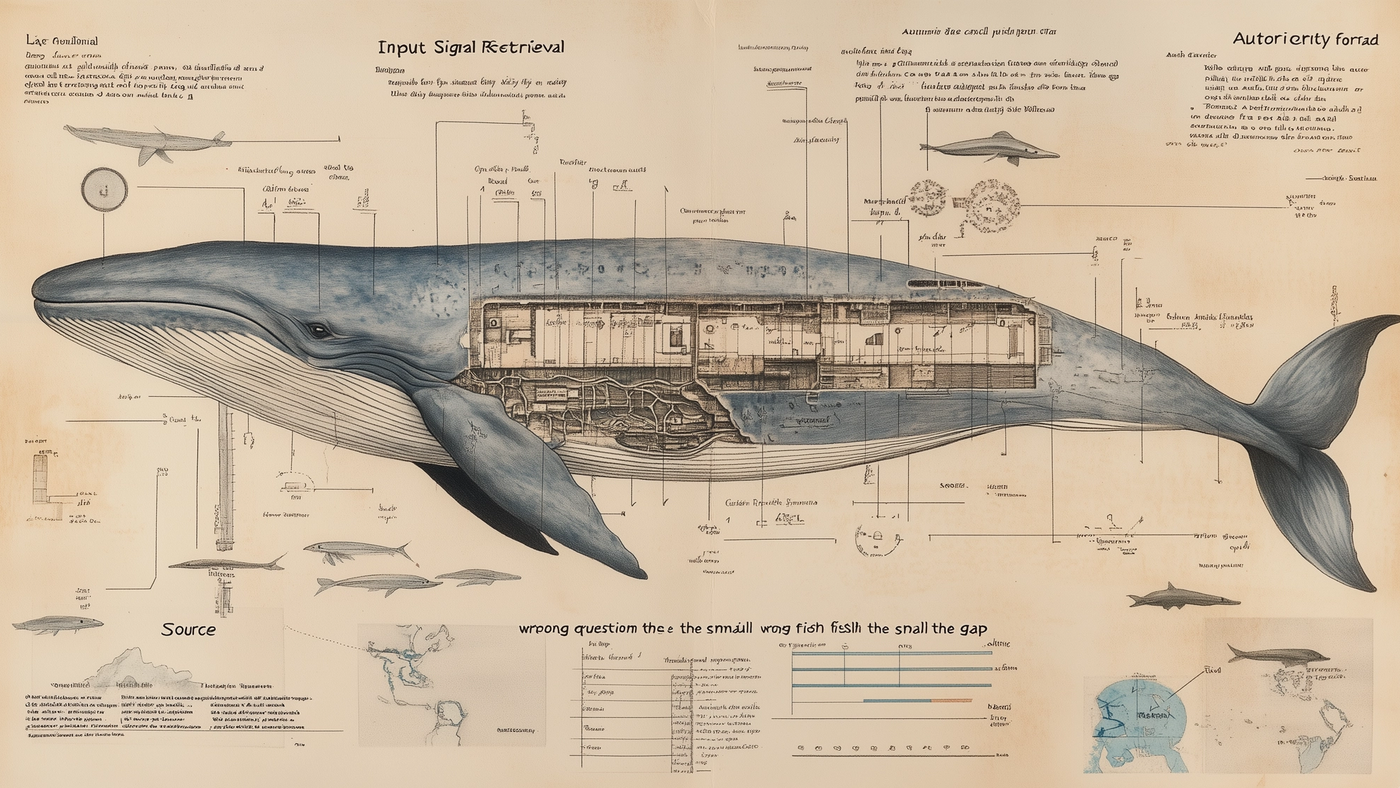
Authoritative pages lose AI search citations when they answer the wrong question
When you ask an AI search engine a complicated question, it doesn't search your exact query. It breaks the question apart into sub-queries and runs them in parallel against its retrieval index. This is query fan-out, the core retrieval behavior that
answer engine optimization is built around. The response you get is an assembly of the best available passage for each sub-query, synthesized into a coherent answer.
Think of it like a research assistant
You ask someone to find a project management tool for a ten-person remote team. A lazy assistant searches that exact phrase and hands you the first result. A good one breaks it down: which tools are popular, how do they handle remote teams, what's pricing like at ten seats, what do people say about onboarding.
AI search works like the good assistant. Multiple sub-queries, then synthesis.
Canva's SVG page gets skipped because it dodges the real question
I had a real workflow issue that I needed an answer to. Does Canva export true vector SVG files or does it rasterize the output? Canva has an SVG editor page. It covers what users can do with the tool. But people searching for this want to know something specific: does the export produce actual vector SVGs, or does it rasterize elements into PNGs?
The official page doesn't answer this question directly. But the Google AI overview did, sourcing Facebook and Instagram posts alongside a Reddit thread. Not Canva's documentation. Facebook and Instagram.
The answer, for what it's worth: complex elements get flattened into embedded PNGs while text and basic shapes stay as vectors. But Canva's page won't tell you that.
Facebook, Instagram and Reddit fill the gap when official pages won't
Someone posted on a Facebook design group. Another on Instagram. A third on Reddit. The comments included actual file size comparisons proving the rasterization. Those were the only places the specific detail existed, so AI retrieved those passages and assembled them into a complete answer.
The AI model needs those specific details to answer the sub-queries. The Facebook post has them. The Instagram comment has them. The Reddit thread has them. Canva's page doesn't. Facebook, Instagram and Reddit get the citation.
There's something kind of absurd about this. The company that makes the product loses the citation to anonymous social posts because they wouldn't document their own export behavior.
How models actually build responses
| Platform | How it retrieves | How it cites |
|---|
| Google AI Overviews | Leans on indexed web content, favors established domains | Fewer citations, weighted toward traditional ranking winners |
| Perplexity | Live web retrieval, real-time indexing, surfaces niche forum content | More citations per response, rewards freshness and specificity |
| ChatGPT with search | Hybrid of parametric knowledge and Bing index, rewards topical depth | Most citations concentrate on top sites, but there's a long tail |
Platform
Google AI Overviews
How it retrieves
Leans on indexed web content, favors established domains
How it cites
Fewer citations, weighted toward traditional ranking winners
How it retrieves
Live web retrieval, real-time indexing, surfaces niche forum content
How it cites
More citations per response, rewards freshness and specificity
Platform
ChatGPT with search
How it retrieves
Hybrid of parametric knowledge and Bing index, rewards topical depth
How it cites
Most citations concentrate on top sites, but there's a long tail
A model answering a complex query uses two things:
parametric knowledge, stuff baked into its training, to frame the question and generate sub-queries, and
real-time retrieval to dispatch those sub-queries and pull from external sources. The final response combines both.
Building actual
topical authority, not just
domain authority, helps across all three. But each one will still skip you if your page doesn't answer the specific question the sub-query is asking.
This trend is accelerating
Google expanded
AI Overviews to roughly 48% of commercial queries as of February 2026 (
BrightEdge data).
Perplexity now averages more than five citations per answer. A
March 2026 paper from the ACL Student Research Workshop found that query decomposition in
RAG pipelines meaningfully improves accuracy on multi-hop reasoning questions.
Models are getting better at breaking questions apart. If your page doesn't answer the sub-query, you're not getting cited.
What this means for your pages
The Canva example is a SaaS product, but the gap is not specific to software. A hotel that describes its rooms thoroughly but never addresses whether the beach access is actually walkable at low tide has the same problem. A tour operator whose itinerary page covers every stop but never answers whether the trails are suitable for people with bad knees has the same problem. An online retailer whose product page covers specs, dimensions, and materials but never answers whether the sizing runs small has the same problem. A law firm whose practice area page covers services offered but never addresses typical timelines or what the intake process actually looks like has the same problem.
Authoritative pages answer the question they were designed to answer. Buyers at the decision moment are asking something more specific. Find the gap between those two questions in your category and write a passage that answers the specific one directly. That passage needs to stand alone as
citation-ready content, complete enough that someone encountering it without the rest of the page would still get the answer they came for."
AI search finds the answer wherever it lives. If that answer is sitting in a Facebook comment thread instead of on your page, that is where the citation goes.