Direct Traffic Is Changing: What 12 Businesses Reveal About AI-Era Search Discovery
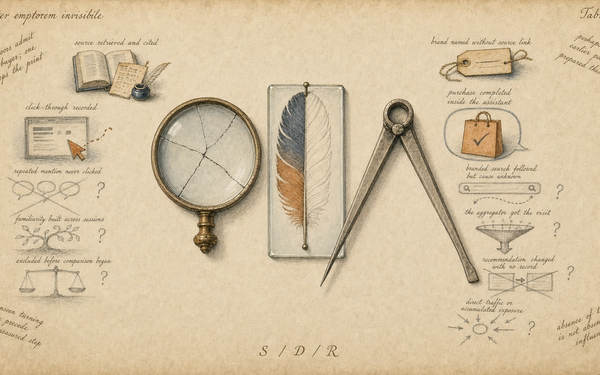
When AI recommends a business and someone types the URL directly, analytics tends to call it direct traffic, mostly.
Read more
Context Map
The Context Map is an AI visibility and entity diagnostic. We run the queries your buyers run, record what the assistants say back about your brand, and trace each claim to the source it came from.
Before you fix anything, you need to know what you are working with. Plate Lunch Collective's Context Mapping service is a structured review of how AI systems currently read your brand. What they know, what they are missing, and where the gaps are costing you citations.
Sources: Page One Power, March 2026. Search Engine Land, April 2024. Search Engine Land, October 2025.
HOW IT WORKS
The instinct is to start with content. More pages, more posts, more structured data. The Context Map starts earlier. Before we build anything, we read the terrain. What do AI systems currently know about your brand? What context are they working from? What's missing, contradictory, or simply not there?
The work is structured and specific. We query AI platforms directly, review how your brand is represented across citation sources, identify the entity signals that are present and the ones that aren't, and trace the content gaps that are preventing you from being cited. The output is a documented map, not a gut feeling.
Most clients use the Context Map as the entry point for an ongoing engagement. Some use it to pressure-test work they've already done. Either way, you walk away knowing exactly where you stand and what it would take to change it.
A Context Map tells you where you stand today. our AI visibility measurement framework covers what we track afterward and how much weight each signal carries.
 ChatGPT
 Perplexity
 Claude
 Gemini
 Meta AI
 Copilot
 DeepSeek
 Grok
GrokCase Study
Elvis was rumored to have worn their stuff. The brand predated Google by decades, predated the web entirely, and had been part of Hawaiian culture long enough that locals remembered specific locations the way people remember places that shaped them. When they encountered the brand today the reaction was always the same: "Oh, they're still around?" Fond memory. Mild surprise. No purchase intent.
The digital footprint told a different story. Cruise ship shuttle stops. TripAdvisor listings filed under shopping near the port. A brand with genuine cultural provenance had been indexed, cited, and recommended as a tourist convenience. Nationally it still moved volume on nostalgia, surfacing in niche searches for Hawaiian clothing. The context AI systems were working from had collapsed decades of real history into a single frame: souvenir shop.
The Context Map found the problem and the asset. Buried in the entity record were citation trails worth killing for. Vintage press, cultural references, decades of organic mentions from sources with real authority. None of it was connected, none of it was current, and none of it was pointing anywhere useful. The first cycle wrote itself: stop starting from scratch and start activating what already existed. Legacy authority redirected at a modern brand presence.
A Context Map shows what AI returns when buyers ask about your category, and what it returns is often a competitor or a trade directory, not the brand.
Before any work starts, a Context Map records whether AI files your farm under agriculture, tourism, both, or nowhere, and which names it offers instead.
A Context Map establishes what models say about your operation today and where they confuse it with similarly named entities, so the starting point is known.
What AI believes about you now is often outdated or attributed to someone who shares your name, and a Context Map captures that picture across platforms before work begins.
A Context Map shows which product questions AI answers with your brand and which it hands to a marketplace, locating the gaps before anything is built.
A Context Map records how AI describes your property, whether it surfaces the right offering, and which competitors it recommends in your place.
When a local buyer asks, AI may not identify your business at all, and a Context Map shows whether it can and which directory it falls back on.
How much of your expertise AI can actually see stays unknown until a Context Map establishes what it can and cannot say about your capabilities.
A Context Map captures how models categorize your product and which competitors they name in the queries that matter, setting the baseline the work is measured against.
A Context Map records what AI says about your formulations and claims today, and whether it points buyers to you or to a brand with a cleaner record.
A brand built on community and image usually assumes AI knows more than it does, and a Context Map shows what it actually knows.
A Context Map records how AI answers the trip questions your buyers ask and where your destination is missing from the response.
A Context Map establishes whether AI connects your service to the specific routes buyers search, and which operators it names when it does not.
A Context Map shows whether AI resolves your brand as a Hawaii business or folds it into a mainland equivalent, marking the starting point for the work.
FAQ
Tell us what you're seeing. We'll get on a call, map the terrain, and show you exactly where you stand.
From the Field