AI Search Optimization for Surf, Fitness & Lifestyle Brands
In surf and fitness, AI already recommends a brand. It isn't yours
You built the brand on feel and following. A look people recognize, a community that shows up. People read it instantly. The systems now deciding who gets recommended read almost none of it. When someone asks an assistant for the best board for a beginner, or searches TikTok for a recovery brand worth trusting, a model picks the names it can read, verify, and cite. Right now it probably isn't you. The brand is good. Nothing told the machine what it is.
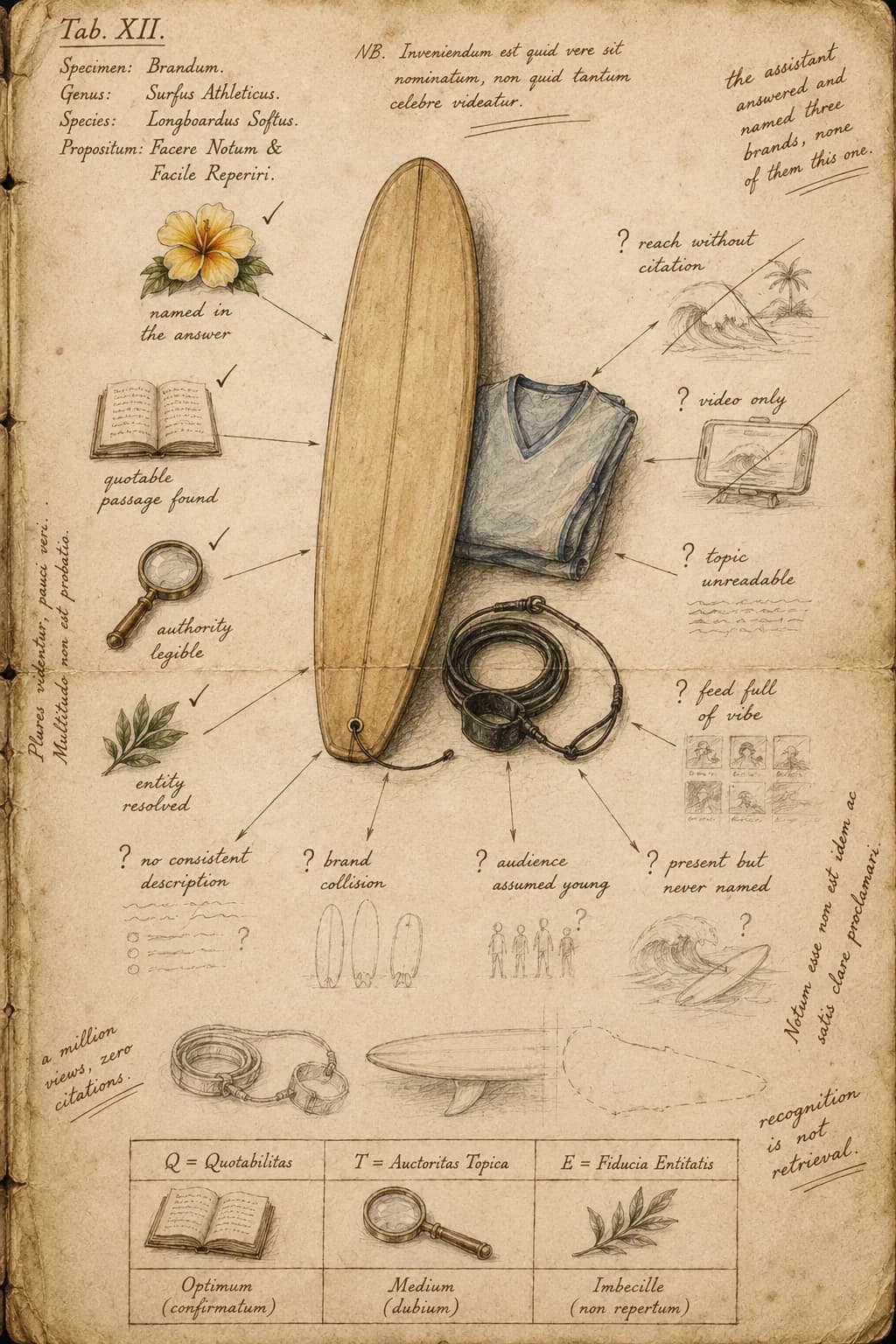
Plate XII. A page from a working notebook, diagnosing how an AI assistant decides whether to name a brand. Three measures run through the observations. Quotability is whether your pages give a model a clear sentence it can lift and attribute. Topical authority is whether platforms can tell what subject you are expert in. Entity confidence is whether your brand resolves to one consistent, verifiable thing across the sources a model trusts. An observation is confirmed when all three clear their thresholds. It stays unresolved when any one of them does not.
How AI search works
The AI visibility gap
Your customers ask. It names someone else.
Search for your category doesn't start at Google anymore. It starts in a conversation with an assistant, or in the search bar on TikTok and YouTube, where an AI decides what you're an authority on and whether you surface at all. Your customers are already there. They research products on social before they buy, and about a third of US adults now turn to AI chatbots for health and wellness information, a rounding error two years ago. The demand is real and growing. The only open question is whether your brand is legible to the systems answering it, or invisible to them.
62%
of US TikTok users say looking at product reviews or recommendations is a reason they use the platform. Social is a search engine now, and a model decides which brands surface.
46%
of TikTok users 50 and older say the same. Every demographic researches on social.
Pew Research Center, survey of 10,287 US adults, March 2024.
Why AI skips your brand
Three reasons AI doesn't name your brand.
GAP 01
Social platforms can’t read what you’re an authority on.
TikTok, Instagram, and YouTube stopped leaning on hashtags a while ago. Their systems read your content to decide what you’re expert in and who should see it. A feed full of lifestyle shots and trend-chasing tells them very little. When the topic you want to own isn’t clear in the content itself, the platform surfaces someone whose authority is legible instead.
Social Search OptimizationGAP 02
Your best work is in a form no model can quote.
A reel that lands a million views gives a language model nothing to cite. Models pull from text they can parse, verify, and attribute: a clear claim, a clear source, a clear answer to a clear question. If your expertise lives only in video and captions, the AI has no sentence of yours to put in its answer, so it uses a competitor’s.
Citation-Ready ContentGAP 03
The model isn’t sure what your brand is.
Before an assistant recommends you, it checks whether you’re a verified entity it can place. For a lot of independent brands the signals are thin or scattered, so the model can’t resolve you with confidence, and a recommendation it isn’t confident about is one it doesn’t make. It reaches for the brands whose identity sits clean and consistent across the sources it trusts.
Entity SEOA brand can have all three gaps at once, and the gaps compound. Fixing your entity signals does nothing if nothing you publish is quotable, and the best writing on the internet stays invisible if the platforms can't tell what it is about.
Where we work
A brand with a following sells well past its own coastline.
FAQ
Questions we get
My customers find us on Instagram and TikTok, not ChatGPT. Why does AI search matter for a brand like mine?
+
Because those platforms are AI-driven search engines now. TikTok, Instagram, and YouTube use the same kind of retrieval logic an assistant does: they read your content, decide what you’re an authority on, and choose whether to surface you. So this isn’t a question of ChatGPT versus social. It’s the same machine reading you across every surface your buyers use, and either finding you legible or passing you over.
We have someone running our social and our content already. Do you work with existing teams?
+
We work through your team, not around them. Whoever runs your social already knows your voice and your community better than we could from outside. Our job is to tell them what a model needs to recognize the brand, work alongside them while the first pages get written, and then step back. The goal is that they can run this without us.
When someone asks an AI assistant for a recommendation in my category, it names other brands. Why them and not me?
+
The model recommends what it can read, verify, and place. It pulls from clear, sourced text and from brands whose identity is consistent across the places it trusts. If your expertise lives mostly in video, or your brand signals are thin or scattered, the model can’t cite you with confidence, so it reaches for the competitors it can. The gap is legibility, not quality.
How do I find out what AI actually says about my surf or fitness brand right now?
+
You ask the models directly, across the questions your buyers really use, on more than one platform, and you record what each model says. That's what a Context Map does: it documents where you surface, where a competitor surfaces instead, and which source the model trusted to get there. You see the real picture before you spend anything changing it. Tracking whether that picture changes over time is a separate discipline, and we publish how we measure AI visibility so you can see what we count as proof.
Does this only work for big brands with budget, or can a small independent label compete?
+
Small and specific often wins here. A model rewards a clear, well-sourced identity over a big vague one. A focused surf or fitness brand with a real point of view is easier to place and cite than a giant that means everything to everyone. Narrow questions have narrow candidate pools, and an independent brand can own a pool the big names never bother to enter.
I already put out a lot of content and video. Isn’t that enough to get picked up by AI?
+
Reach and retrieval are two different jobs. A video that performs proves demand exists, but it gives a language model nothing to quote. Models cite text they can parse and attribute: a clear claim, a clear answer, a clear source. Getting picked up by AI means having that quotable, structured material, not just volume. A brand can have the expertise and none of it in a form a model can lift.
How does an engagement actually work, and what do I walk away with?
+
It starts with a Context Map that shows where you stand. From there we build the entity signals, the citable content, and the social legibility that get you retrieved, then measure the change against the questions your buyers use. PLC works as an ongoing partner. The work runs in 90-day cycles: each quarter has a defined scope, you own everything produced, and knowledge transfers throughout. Every 90 days the results go on the table and both sides decide what the next quarter is for.
Start with a read on where your brand stands.
A Context Map shows you which questions your buyers ask AI and social platforms, who gets named instead of you, and what the systems would need to see to change the answer. Before you spend anything fixing it.