AI Search Optimization for Agribusiness
Growers ask AI which supplier serves their crop and their county and your company is not in the answer
Seed, fertilizer, crop protection, irrigation, equipment, parts. Your specs are documented to the decimal because regulation and sales require it. Which crops you serve, which regions you cover, and which dealers carry you are usually written nowhere at all.
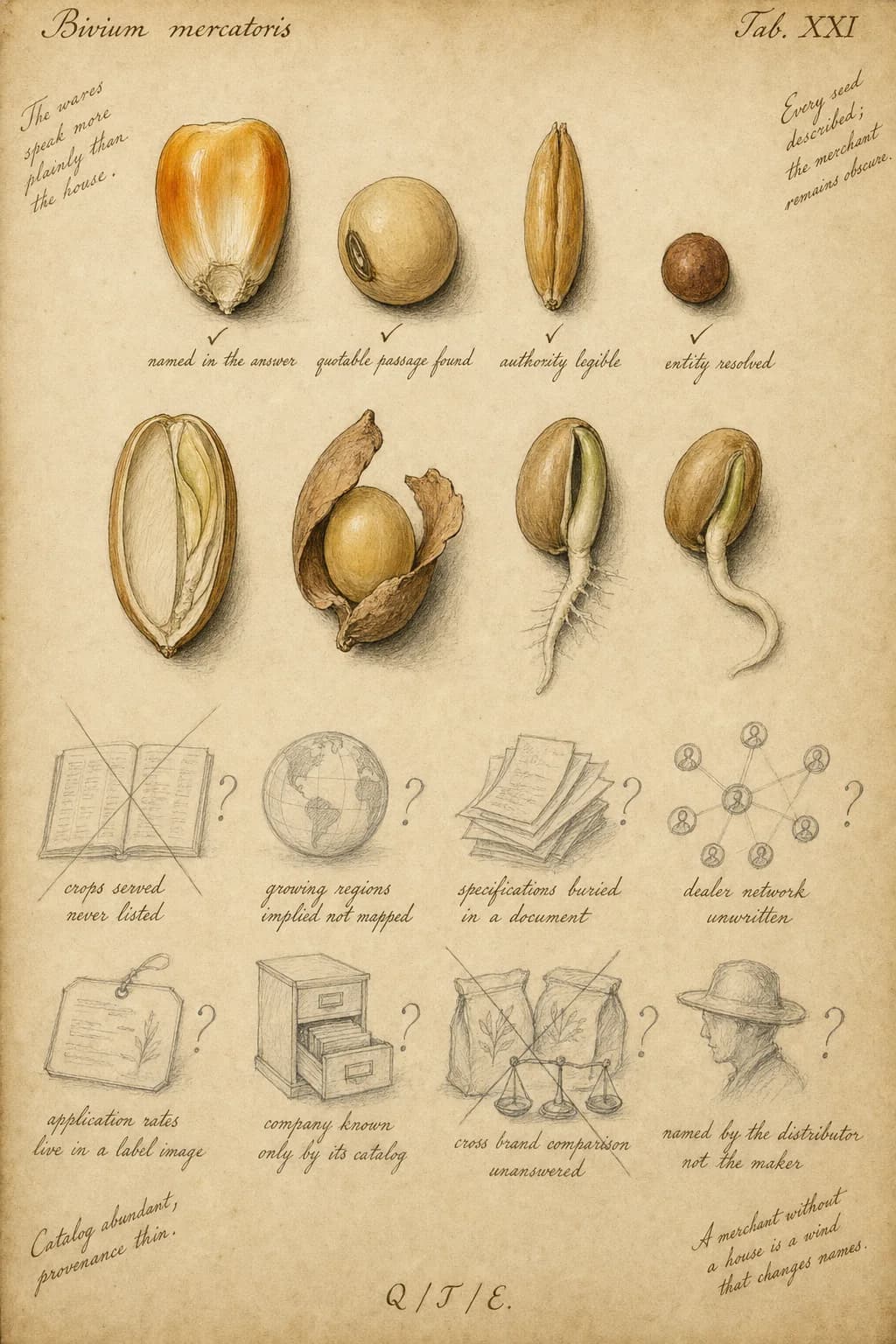
Agricultural suppliers document products in exhaustive detail and document the company almost not at all. Spec sheets, label data, and application rates exist because regulation and sales require them. The facts a buyer needs in order to evaluate a supplier, which crops, which regions, which conditions, which dealers, are rarely written anywhere a model can read. A margin note on the plate reads: Catalog abundant, provenance thin.
One question, four lanes
A model does not answer a question. It breaks the question apart, answers each piece from whatever it can read, and reassembles the result. Here is what happens to a supplier sourcing query.
The AI visibility gap
The spend is documented. The decision is not.
US farms buy seed, fertilizer, crop protection, irrigation, and equipment at a scale measured to the decimal. Which supplier earns each purchase gets decided in a question that lands somewhere no one has written down.
$477.6 billion
spent by US farms on production expenses in 2024. Feed accounted for $73.1 billion, fertilizer and soil conditioners $33.8 billion, seeds and plants $27.4 billion, agricultural chemicals $21.7 billion, and tractors and self propelled machinery $21.0 billion.
USDA National Agricultural Statistics Service, "Farm Production Expenditures 2024 Summary," July 2025. n=40,282 sampled US agricultural operations, list and area probability frames with sampling weights, calibration, and imputation. Collection ran December through May by mail, web, telephone, and in person. National response rate 45.3 percent. The $477.6 billion total covers 17 expenditure categories and includes labor, rent, interest, and taxes alongside purchased inputs and equipment.
A note on the figure
One number instead of two, on purpose. The second card would normally carry research on how agricultural buyers use AI to find suppliers. That research does not appear to exist. We looked, and what we found instead is described below.
What the model cannot read about your company
Three reasons AI doesn't name your company.
GAP 01
Your products are documented. Your company is not.
Spec sheets, label data, application rates, tank mix compatibility, tolerance ranges. All of it exists in detail because regulation and sales require it. Then a grower asks which supplier serves macadamia on volcanic soil at elevation, and the answer requires facts nobody wrote down. Which crops the line was built for. Which regions the dealers cover. What conditions the product holds up in. A model can quote your tolerance range and cannot say whether you serve the person asking.
GAP 02
The industry measured AI pointed at the field and never measured AI pointed at the purchase.
We went looking for research on growers using AI to find and compare suppliers. What came back was study after study on precision agriculture, yield prediction, crop scouting, autonomous equipment, and agronomic question answering. Farmers using AI to farm has been surveyed thoroughly by equipment makers, input companies, and university programs. Growers using AI to decide who to buy from has not been surveyed at all, as far as we can find. The gap in the research and the gap in supplier documentation come from the same instinct.
GAP 03
The platform assistants are built to answer for one catalog.
Syngenta documented Cropwise AI as an Amazon Bedrock agent retrieving from Syngenta seed catalog data and Syngenta agronomic models. Farmers Business Network says Norm was built from GPT-3.5 and supplied with USDA data, extension material, product labels, and FBN's own analytics. John Deere's Operations Center assistant searches Deere manuals and links to Deere parts pages. These systems are useful and they are bounded by whoever built them. Every cross brand question a grower has, every comparison, every supplier the catalog does not carry, goes somewhere else. That somewhere else is the open web, and it is the part you control.
The work is writing down the company with the same care the products already get. Crops served, regions covered, conditions handled, dealers who carry you, stated as facts in text rather than implied by a catalog.
Where we work
Suppliers are known by the regions they actually serve.
FAQ
Questions we get
Our buyers are growers and dealers who have known us for years. Does AI search matter for that?
+
It matters for the buyers who do not know you yet. An established dealer relationship is not at risk from an AI answer. A grower switching suppliers, expanding into a new crop, or replacing a system after a failure is starting from a question, and that question increasingly goes to a model before it goes to a dealer. The existing book stays. The next book is the one being decided somewhere you cannot see.
We have a marketing team and an agency already. Do you work with existing teams?
+
We work through your team, not around them. Your people know which crops your line actually performs in and which regions your dealers actually cover, and that knowledge is the raw material for all of this. Our job is to tell them what a model needs, work alongside them while the first pages get written, and then step back. The goal is that they can run this without us.
Our products are sold through distributors. Does that change anything?
+
It makes the company level documentation more important. When a grower asks a model about a product sold through distribution, the distributor is often the entity that gets named, because the distributor is the one with the web presence. The manufacturer sits behind the catalog. Writing down what you make, which crops it serves, and who carries it gives the model a reason to name the maker alongside the seller.
How do you know whether any of this worked?
+
We run the questions your buyers actually ask, before and after, across the models they use. Whether the company is named. Whether the answer connects you to the right crop and the right region. Whether a stated constraint like soil type or terrain or application window pulls you into the answer. Here is how we measure whether growers can find you.
Our competitors have their own AI assistants inside their platforms. Can you get us into those?
+
No, and anyone who says otherwise is selling something. A platform assistant built to place one company's seed is going to place that company's seed. What we can do is make sure that every question those systems will not answer, which is every cross brand comparison and every supplier outside the catalog, finds you when it lands on the open web. That is where those questions go.
Most of our technical detail is in PDFs and label images. Is that a problem?
+
It limits what a model can use. A PDF is readable by some systems and skipped by others, and a label rendered as an image is text a machine cannot extract at all. The fix is not deleting the PDFs. It is making sure the facts inside them also exist as text on a page, particularly the facts a buyer uses to decide: crops, regions, rates, conditions, compatibility.
What does this actually look like for a company our size?
+
Mostly writing, and mostly writing things your sales team already says out loud. A page for each product line that states which crops it serves and under what conditions. A page that says where your dealers are. Company facts stated plainly enough to be quoted. Structured data connecting the products to the company that makes them. Then the slower work of getting that description corroborated in places a model already trusts, which in agriculture usually means extension material, trade associations, and dealer listings you are already part of.
Start with a read on where your company stands.
The Context Map is a fixed-scope diagnostic that shows how AI search treats your company in your market.