AI Search Optimization for Skincare and Beauty
Buyers ask AI whether your sunscreen is reef safe and the answer comes from someone else's blog
Skincare, sunscreen, haircare, fragrance, cosmeceuticals, ingestible beauty. Your ingredient panel is filed with FDA and printed on the box. Whether the formulation suits oily skin, what the actives are dosed at, and who tested the claim are questions your buyer is now asking a model, and the model answers from whatever it can read.
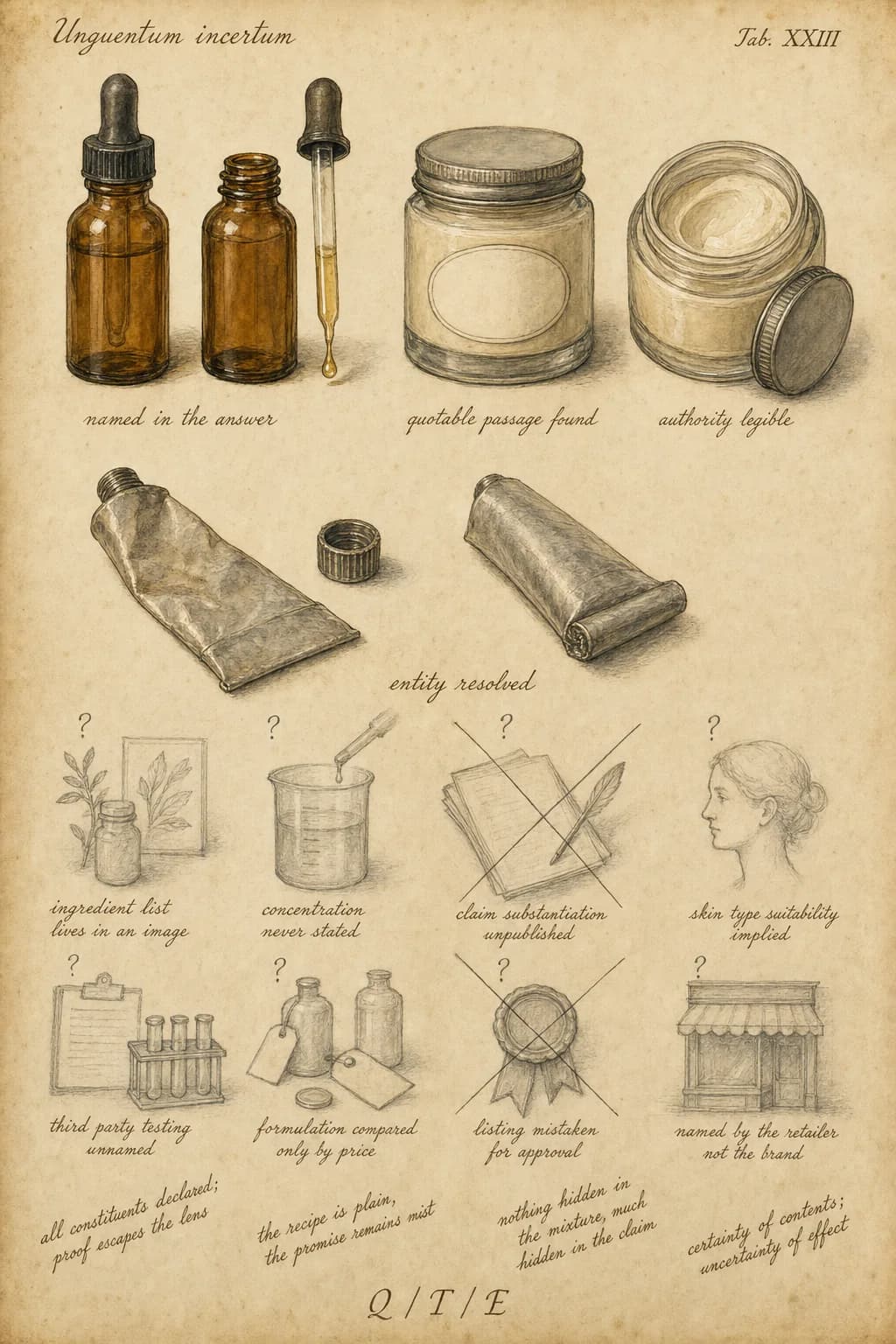
FDA holds 1,298,361 active cosmetic product listings and states plainly that listing is not approval. A buyer facing that many products with no approval signal has every reason to ask a model instead of reading the box. The model answers from whatever the brand wrote down in text, which is rarely the concentration, the substantiation, or the suitability. A margin note on the plate reads: Certainty of contents, uncertainty of effect.
One question, four lanes
A model does not answer a question. It breaks the question apart, answers each piece from whatever it can read, and reassembles the result. Here is what happens to a product verification query.
The AI visibility gap
A vast field, no approval signal, and claims defined by others.
The catalog is enormous and the label is legally silent on whether a product works for the person asking. A buyer turning to a model is answering that. The narrowing runs on documented facts, so the products named are the ones whose facts exist as text.
1,298,361
active cosmetic product listings held by FDA, across 16,398 registered facilities. FDA states that listing does not mean the product is approved.
US Food and Drug Administration, cosmetic product facility registration and product listing data under the Modernization of Cosmetics Regulation Act, as of June 30, 2026. Administrative counts of unique active listings and registrations submitted by industry. FDA states explicitly that registration and listing are neither approval nor endorsement, and that listing data should not be used to suggest FDA approval of a product.
A note on the figure
One number instead of two. The second card would normally carry research on how skincare buyers use AI to check ingredients and claims. We looked across FDA, FTC, NAD, Mintel, NIQ, Circana, and the beauty trade press and did not find it. Products built to do exactly that verification exist and sell. The behavior they serve has not been measured.
What the model cannot read about your formulation
Three reasons AI doesn't name your formulation.
GAP 01
The panel is filed. The answer is not written.
Your INCI list exists, on the box and in the FDA listing. Then a buyer asks whether the formulation suits oily skin, what the active is dosed at, or who ran the testing behind a claim. Those are different facts, and they usually live in a product photo, a PDF, or a sentence of marketing prose that states a feeling rather than a fact. A model can retrieve your ingredient list and cannot answer the question that was actually asked.
GAP 02
Unregulated claim language is defined by everyone except you.
Reef safe, clean, non comedogenic, hypoallergenic, dermatologist tested. Several of these carry no federal definition. When a buyer asks a model what one of them means, the model assembles an answer from retailers, advocacy organizations, and editorial coverage, because those sources wrote definitions down and brands generally did not. The term ends up defined by third parties, and your product is evaluated against a definition you had no part in setting.
GAP 03
Being one of 1.29 million listings is the problem the model is being asked to solve.
FDA holds over 1.29 million active cosmetic product listings and says plainly that listing is not approval. That is the situation from the buyer's side: an enormous field, no approval signal, and claim language that varies by who is using it. Asking a model to narrow that field is a reasonable response to it. The narrowing happens on documented facts, so the products that get named are the ones whose facts exist as text.
State in plain text what the label implies and the marketing gestures at. Actives and their concentrations, who the formulation is for, what a claim means in your usage and what backs it.
Where we work
Beauty crosses borders. The label still has a home.
FAQ
Questions we get
We sell mainly through retailers and Amazon. Does our own site matter for this?
+
It matters because the retailer listing is not yours. When a model answers a question about your product, it draws on whatever describes that product across the web, and retailer pages are written to sell a catalog rather than to explain your formulation. The brand that publishes its own specifics gives the model something to quote that came from the source. The retailer page stays. It stops being the only description that exists.
We have a brand team and an agency running content already. Do you work with existing teams?
+
We work through your team, not around them. Your formulators and your customer service people already know the answers to the questions buyers ask, including the ones that never make it onto a page. Our job is to tell your team what a model needs, work alongside them while the first pages get written, and then step back. The goal is that they can run this without us.
Our claims go through regulatory and legal review. Will this create compliance risk?
+
Nothing here asks you to make a new claim. It asks you to state, in text a machine can read, what you have already substantiated and already say on the box. If a claim survives your regulatory review for a label, it can be written on a page with the same language. Where a claim cannot be substantiated, the answer is not to write it down, and that is a decision for your regulatory team rather than for us.
How do you know whether any of this worked?
+
We run the questions your buyers actually ask, before and after, across the models they use. Whether the product is named. Whether the answer carries your actives and their concentrations. Whether a stated constraint like skin type, sensitivity, or a specific claim pulls you into the answer or leaves you out of it. Here is how we measure whether your formulation is legible.
Our ingredient information is in the product images. Is that a problem?
+
It limits what a model can use. Text rendered inside an image is not reliably extractable, so an ingredient panel that exists only as a photograph of a box may as well not exist for retrieval purposes. Keep the images. Add the same information as text on the page, particularly the actives, the concentrations where you disclose them, and who the formulation is intended for.
We are a small indie brand competing with companies that outspend us. Does this favor them?
+
Documentation is cheaper than media. A large brand with vague claims and a small brand with specific documented ones are not evenly matched when a model is looking for facts to quote. Specificity is the thing being rewarded here, and specificity is available to a company of any size. The constraint is willingness to state things plainly rather than budget.
What does this actually look like for a brand our size?
+
Mostly writing. A page per product that states the actives and what they are dosed at, who the formulation is for, and what it is not for. Claim language defined in your own words with whatever supports it. Ingredient information as text rather than only as an image. Structured data connecting products to the brand that makes them. Then the slower work of getting that description corroborated where a model already looks, which in beauty usually means retailer listings, ingredient databases, and editorial coverage you are already part of.
Start with a read on where your formulation stands.
The Context Map is a fixed-scope diagnostic that shows how AI search treats your brand and your products in your category.