AI Search Optimization for Local Businesses
The business is right there. The AI recommends the one down the block
Someone two streets away opens an assistant and asks who to call. They get a real answer, three names, hours, a reason to pick one. You have been on that corner for eleven years and you are not on the list. The model is not judging your work. It could not confirm what you are, where you are, or whether you are open, so it named a business it could confirm.
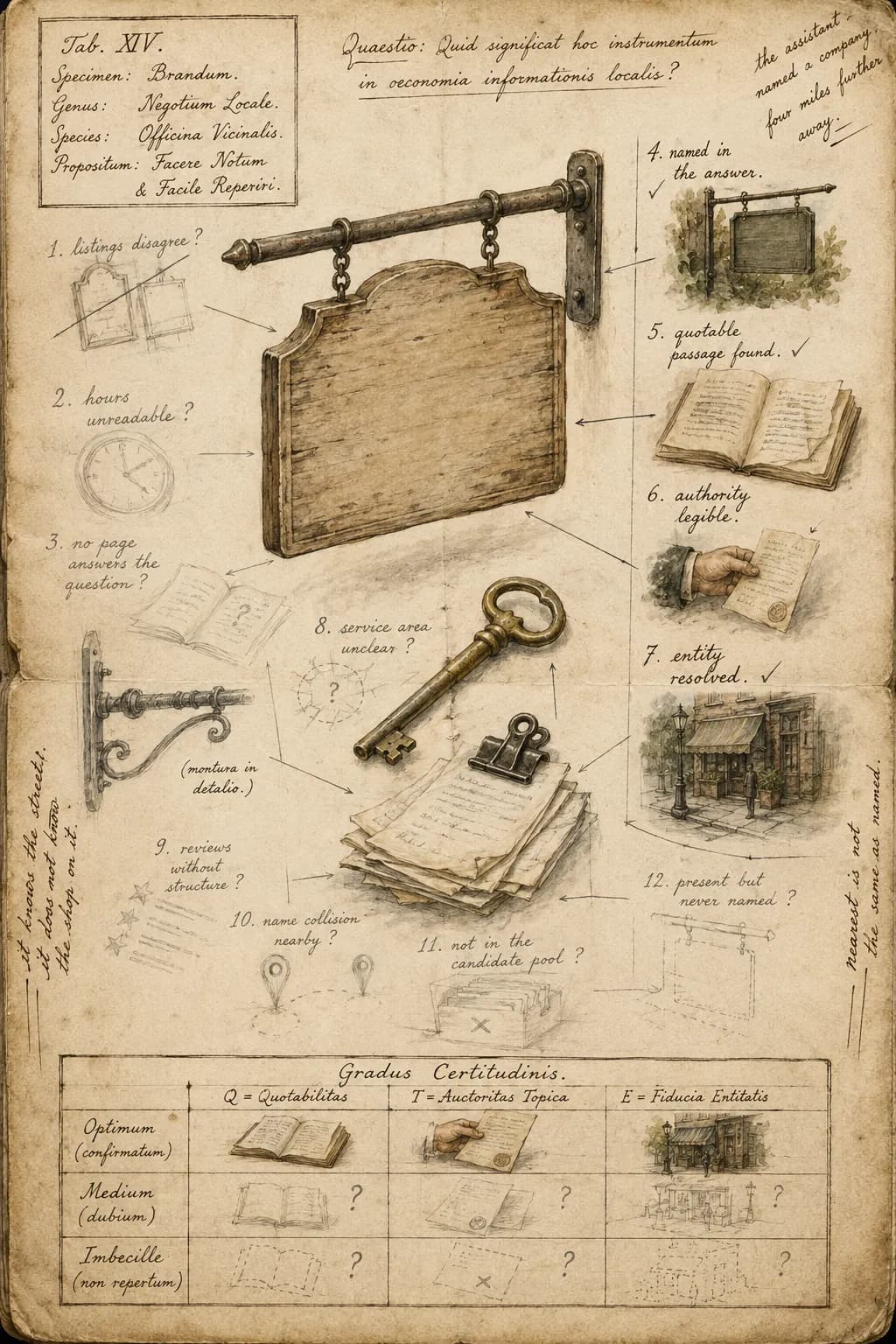
Plate XIV. A page from a working notebook, diagnosing how an AI assistant decides whether to name a local business. Three measures run through the observations. Quotability is whether your pages give a model a clear sentence it can lift and attribute. Topical authority is whether platforms can tell what you actually do and where. Entity confidence is whether your business resolves to one consistent, verifiable thing across the listings and sources a model trusts. An observation is confirmed when all three clear their thresholds. It stays unresolved when any one of them does not.
How AI search works
The AI visibility gap
People ask AI who to call. It names someone.
A local search used to open with a map and a list. Now it often opens with a question to an assistant, and the answer comes back as two or three names with a reason to pick one. Whether yours is among them turns on something the model settles before it speaks: can it confirm what you are, where you are, and whether you are open.
When your listings agree, that confirmation is easy and you get named. When they disagree, the model cannot resolve you, and it reaches for a business it can. The customer never sees the businesses that did not make the answer.
47%
of US adults used an AI tool to find a local business in the past month, rising to 59% among daily searchers.
62%
immediately search Google after an AI recommends a business, and 58% go to the business website. Getting named is the start of the check, not the end of it.
Yext 2026 Consumer Search Behaviors Report. n=1,120 US adults, March 2026.
Why AI skips your business
Three reasons AI doesn't name your business.
GAP 01
Your listings do not agree with each other.
The address on your site, the one on your Google profile, the one on an old directory page from 2019, and the one a review site scraped years ago. A model checks whether it can resolve you to one confident answer. When the sources contradict, it cannot, and an answer it is not confident about is one it does not give.
Entity SEOGAP 02
No page on your site answers the question being asked.
Buyers do not ask who does plumbing. They ask whether a leaking dishwasher is a DIY job and who can come before Saturday. If nothing you have published answers that in plain language a model can lift, there is nothing of yours to cite, so it cites somebody else.
Citation-Ready ContentGAP 03
You are not in the set it chooses from.
Before an assistant names anyone, it assembles a short list of businesses it considers valid for that question in that place. Miss that list and you are not losing the comparison, you are not in it. You rarely learn this happened.
Answer Engine OptimizationA local business can have all three gaps at once, and the gaps compound. Fixing your listings does nothing if no page answers the question a buyer actually asked, and the clearest page on your site stays invisible if a model cannot confirm which business it belongs to.
Where we work
One town is the whole business, and we cover a lot of towns.
FAQ
Questions we get
My customers find me on Google Maps and word of mouth. Why does AI matter for a business like mine?
+
Because a growing share of those customers now ask an assistant first, and the assistant hands back a short list rather than a map. Nearly half of US adults used an AI tool to find a local business in the past month. If you are not in the answer, you are not in the consideration set, and you will never see the traffic you did not get.
We already have someone who built our site and manages the Google listing. Do you work with existing teams?
+
We work through your team, not around them. Whoever set up your site and your listing already knows your business and your customers. Our job is to tell them what a model needs to name you for the searches that matter, work alongside them while the first pages get written, and then step back. The goal is that they can run this without us.
When someone asks an AI for a business like mine, it names competitors. Why them?
+
The model names businesses it can confirm. Consistent listings, hours it can read, a page that answers the question, reviews it can parse. If your details disagree across the places it checks, it cannot resolve you with confidence, so it reaches for a competitor it can. Proximity does not decide it. Legibility does.
How do I find out what AI says about my business right now?
+
You ask the models the questions your customers actually ask, across more than one platform, and you record what comes back. A Context Map documents where you surface, who surfaces instead, and which source the model trusted. Confirming the picture actually changed after the work is a separate discipline, and we publish how we measure whether it moved and what each signal can prove.
I only serve one town. Is this worth doing at that scale?
+
Small service areas are easier to win, not harder. A narrow question has a small candidate pool, and a business with clear, consistent, well-answered pages can occupy a pool that larger competitors never bother to enter. The work is the same. The competition is thinner.
I already have a Google Business Profile. Isn't that enough?
+
It is one source among many, and it is necessary rather than sufficient. A model cross-checks your profile against your site, directories, and review platforms. When those disagree, the profile alone does not settle it. What settles it is the same story in every place a model looks.
How does an engagement actually work, and what do I walk away with?
+
It starts with a Context Map showing where you stand. From there the work turns to the listings that disagree, the pages that do not yet answer the question, and the entity signals a model uses to confirm you. PLC stays on as an ongoing partner. The work runs in 90-day cycles: each quarter has a defined scope, you own everything produced, and knowledge transfers throughout. Every 90 days the results go on the table and both sides decide what the next quarter is for.
Start with a read on where your business stands.
A Context Map shows you which questions your buyers ask AI, who gets named instead of you, and what the systems would need to see to change the answer. Before you spend anything fixing it.