Service Areas
Where we work
The United States, Canada, the Caribbean, and Central America, with on-island depth in Hawaii. A deliberate footprint: markets we know from the inside, not a global list that treats everywhere the same.
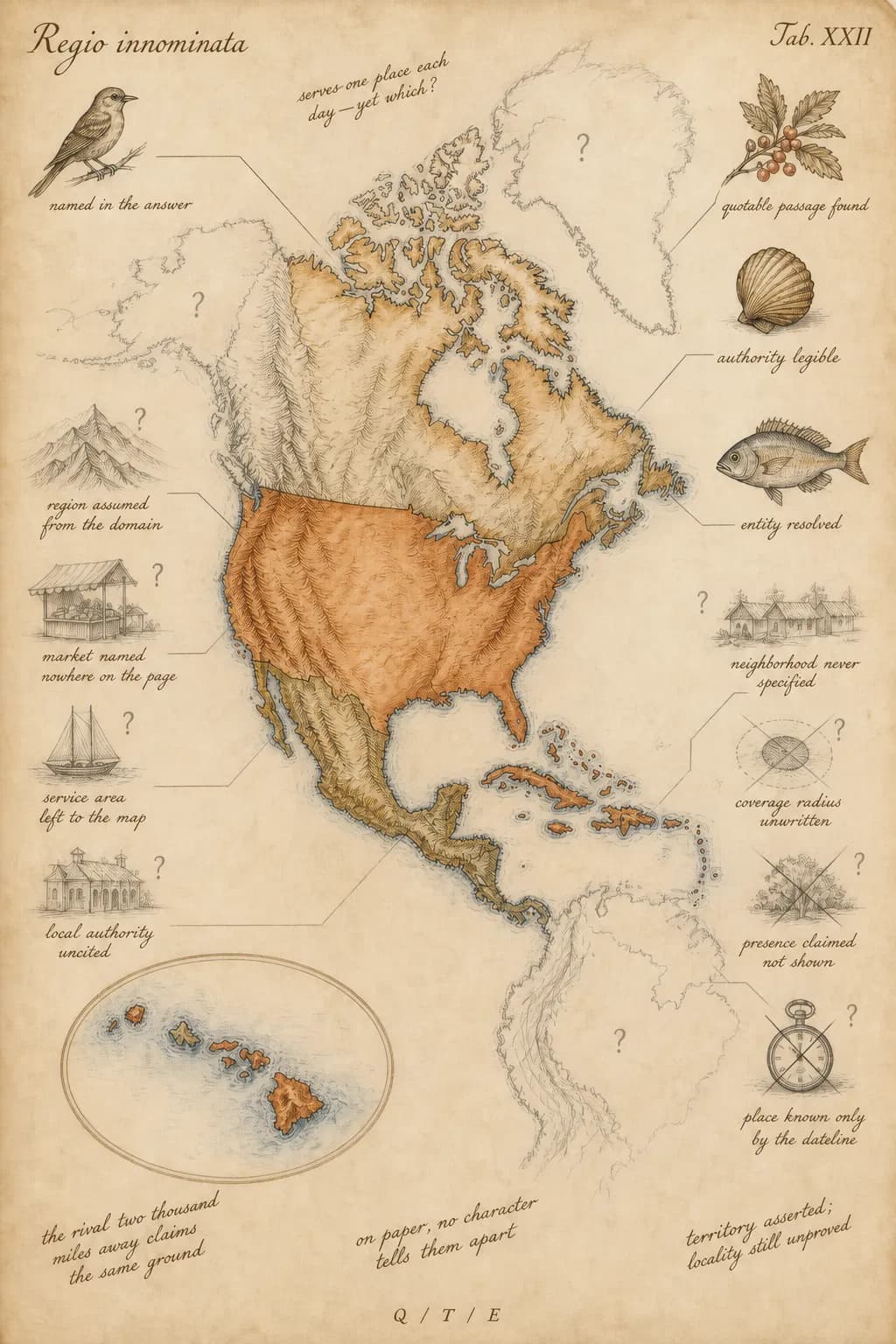
A page from a working notebook, diagnosing how an AI assistant decides whether to name a business in a given place. Three measures run through the observations. Quotability is whether your pages give a model a clear sentence it can lift and attribute. Topical authority is whether platforms can tell what subject and market you are expert in. Entity confidence is whether your business resolves to one consistent, verifiable thing across the sources a model trusts. An observation is confirmed when all three clear their thresholds. It stays unresolved when any one of them does not.
Why the footprint is deliberate
Plate Lunch Collective is run by one person, and that is deliberate. I'm based in Hawaii, and I've lived and worked from all the places this agency serves: the mainland US, Canada, the Caribbean, Central America. Worked from the ground, often onsite, the way you only can when you've lived somewhere. You learn which names locals trust and which ones only tourists use, and when those two views don't match, a business gets found by half the people looking for it. Knowing both, from the inside, is what I bring to the work.
The coverage ledger
Every market, and how deeply we know it.
Ranked by depth of local knowledge, from broad full-service coverage to on-island fluency.
United States & Canada
Caribbean & Central America
On Island, Hawaii
United States & Canada
Coverage
Nationwide, both countries
Where the depth is
Where most demand sits. The complete agency here, not a scaled-down regional offering.
What we lead on
Entity signals, retrieval-ready content, and the measurement to prove presence.
Caribbean & Central America
Coverage
Across both regions
Where the depth is
A lot of the interest in a business here starts before anyone arrives, someone planning a trip and asking an AI assistant what to book.
What we lead on
The name that's already there before anyone starts asking.
On Island, Hawaii
Coverage
Oahu · Maui · Kauai · Hawaii Island
Where the depth is
On-island and time-zone aligned with local operators, fluent in how residents, visitors, and remote buyers each search for a Hawaii business.
What we lead on
Three audiences, three different query sets, each gets its own answer.
Industries
Does industry change how AI search sees you?
It changes the queries, not the method. Becoming named, quotable, and resolvable is the same work in every vertical. What differs is the questions a model is answering when your name should come up, and the industry sets those questions. A visitor planning a trip, a buyer comparing vendors, and a resident looking for something local each ask differently.
Where demand starts before arrival
Where buyers compare before they commit
Where reputation is built in public
Common questions
What people ask before working with us
Does an AI search agency need to be local to my market?
It needs to know your market from the inside, which is not the same as sitting in it. The signals that decide whether a model names you are the same everywhere. Reading them correctly depends on knowing how people in a specific place actually search, and which local names they trust.
Can you change how ChatGPT or Perplexity describes my business?
Not directly, and anyone claiming otherwise is guessing. What changes a model's answer is the source material it draws on. The work is making your business named, quotable, and resolvable across the pages those systems read, so the description they assemble is accurate.
Do you only work with Hawaii businesses?
No. Hawaii is where the depth is, but the full service covers the United States and Canada, with specialized coverage across the Caribbean and Central America. The coverage ledger above shows what each market gets.
How is this different from regular SEO?
It builds on it. Traditional SEO earns you a place in the ranked list of links, and that still matters. This adds the layer above it: the moment a model decides whether to name you at all, and whether it can quote and attribute you when it does. Same foundation, one more surface to win.
Find out where you stand in your market.
Apply and the first cycle starts from how AI search treats your business in your market. If you want that picture before committing to anything, the Context Map is our fixed-scope diagnostic.