AI Search Optimization for Tourism
When travelers ask AI where to go and what to do, you're not in the answer
The trip gets shaped before anyone visits your site. A traveler describes what they want in a sentence, the assistant breaks that into searches they never see, and a few operators come back by name. Half of those travelers then go check. What you sell is decided in a room you are not in, and then confirmed on a page you do not control.
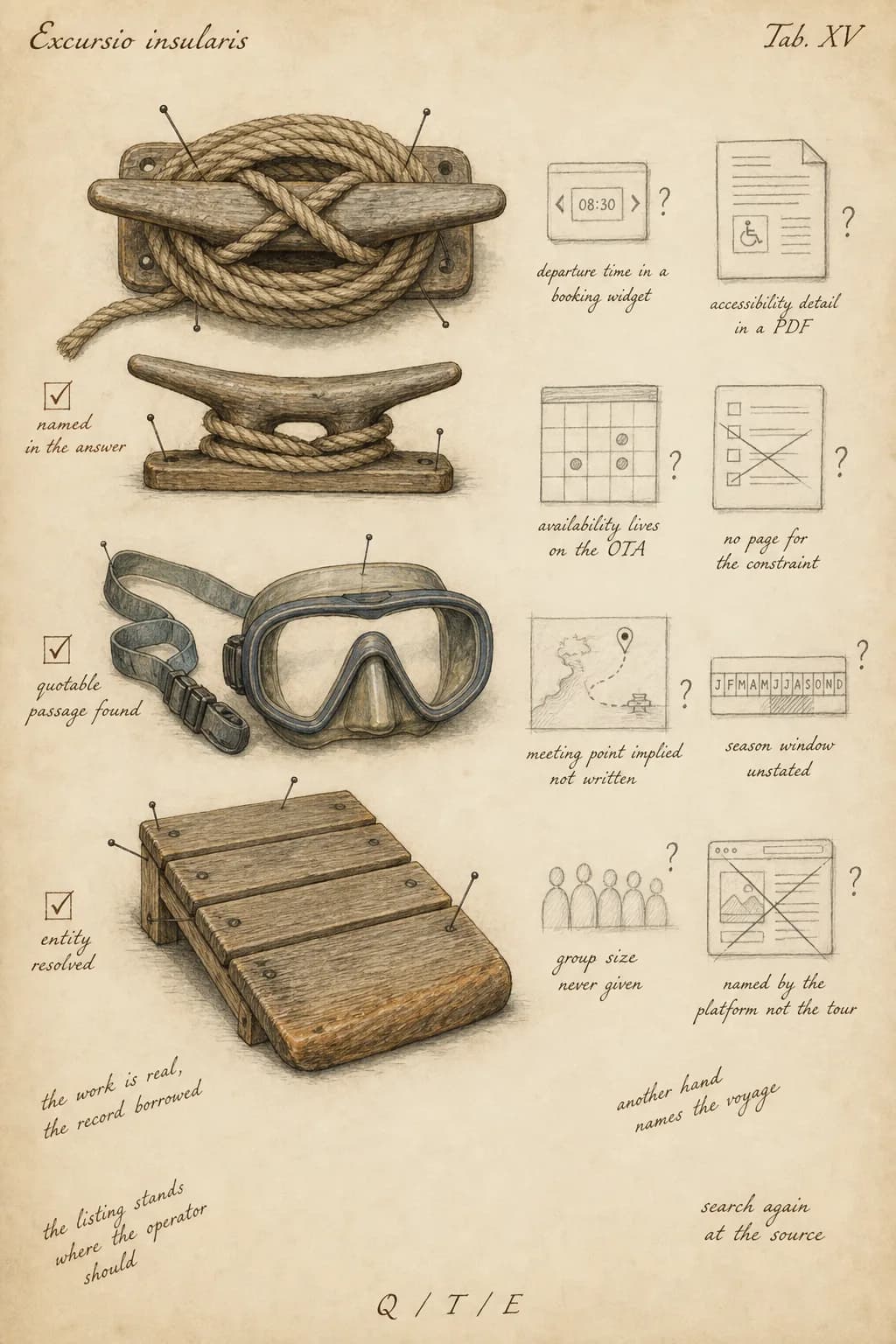
The confirmed specimens are the facts an assistant has tied to your listing and will name in an answer. The unresolved sketches are the details it cannot read, a departure time locked in a booking widget, availability that lives on an OTA, a constraint you never wrote a page for, so a traveler asking for exactly what you offer is sent to whoever wrote it down. The margin note reads: another hand names the voyage, search again at the source.
How AI search works
The AI visibility gap
The trip now starts inside the assistant.
The research step moved. A traveler describes the trip in a sentence, reads back the handful of operators that come out, and only then goes to check. The two figures on the right measure how far that has gone and how often the traveler still clicks through to confirm.
The operators the assistant already names get the click that closes the sale. The ones it cannot retrieve are not lower in the answer. They are absent from the room where the shortlist gets built.
33%
of trip research now runs through generative AI, against 35% for traditional search. Five times what it was in 2024.
Phocuswright, The AI Surge. n=1,570 US leisure travelers, February 8 to 17, 2026.
51%
of travelers clicked through to check the AI answer. Only 8% found it sufficient on its own.
Phocuswright, The AI Surge. n=1,570 US leisure travelers, February 8 to 17, 2026.
Why AI skips your listing
Three reasons AI doesn't name your listing.
GAP 01
You are not in the pool the answer gets built from.
The assistant retrieves a handful of operators and assembles the answer from those. Everything outside that retrieved set is invisible to the answer. The operators who were not retrieved are not ranked last; they are not present, and nobody sees them, including you.
GAP 02
You get named, and then you fail the check.
Half of travelers click through after the assistant answers. They arrive to confirm one specific thing the model said about you, usually the thing that made them pick you. If your page does not confirm it in the first screen, the recommendation dies on your own site.
GAP 03
What you actually offer lives where the model can't read it.
Departure times in a booking widget. Opening hours and ticket types on a page built for humans, not machines. Accessibility detail in a PDF nobody opens. Availability on an OTA listing that names the OTA. The assistant cannot cite a calendar or an hours table it cannot parse, so it recommends the operator who wrote it down in a sentence.
Three of the four figures on this page describe one behavior. The trip starts in the assistant and it does not end there.
Where we work
Every destination runs its own operators to be found among.
FAQ
Questions we get
Do travelers actually book from AI answers, or just research?
+
Mostly research, and that is the point. Only 8% of travelers said the AI answer was enough on its own, and 51% clicked through afterward to check it. The assistant is not taking the booking. It is deciding which handful of operators get considered, then handing the traveler to a site to close. Being in that set is the whole game, because the ones who are not in it never get looked at.
We have someone who runs our marketing and social. They're out of their depth on AI. Do you work with existing teams?
+
Yes, and that is the usual shape of it. Most operators we work with have someone capable running the marketing and the socials, and that person has not had a reason to learn how AI answers get built yet. We work through your team, not around them. We do the parts that need the specialized knowledge, entity structure, the content the model can read, and the measurement, and we hand back the reasoning so your people can carry it. The goal is that your team can run this without us, not that they stay tied to us.
We're listed on the big OTAs. Doesn't that cover us?
+
It covers the OTA. When an assistant pulls from an OTA listing, the citation and the recognition go to the platform, and you show up as inventory inside someone else's answer. It works, and it costs you the commission and your name. Operators who also have their own readable pages show up as themselves, which is the difference between being booked and being resold.
How do we know if any of this moved?
+
We build a set of queries the way travelers actually ask, the place plus the constraint plus the kind of thing they want to do, and run them across the assistants on a schedule. Then we track whether you surface, in what position, and against whom. The measure is not traffic. It is whether you are in the answer for the trips you actually run. Here is what AI visibility measurement actually tracks.
Our tours are seasonal and availability changes weekly. Can AI keep up?
+
Not with your calendar, and it does not need to. Retrieval works on the durable facts, what the tour is, who it suits, where it leaves from, what the constraints are, what the season looks like. Availability is what the traveler checks on your site after the assistant sends them. Write the durable part down where the model can read it, and let the live part stay in your booking system where it belongs.
We're a small operation, one boat or one small site. Is this only for big operators?
+
Small operators often do better here. Retrieval rewards a clear, specific match to a specific question, and a single operator who does one thing for one kind of visitor is easier to place and cite than a large one who does everything for everyone. Scale buys reach in traditional search. It matters less in a system looking for the cleanest answer to a specific trip or visit. If you are the obvious answer to a real question, size is not what decides it.
How long before an assistant starts naming us?
+
Structural fixes show up in retrieval within weeks, once the durable facts about your tours live in text the model can read. Entity resolution and citation footprint move over months, because they depend on third-party sources updating on their own schedules. Watch presence first, whether you appear at all for your core trips, then position, whether you are named early or buried. Frequency comes after presence.
Start with a read on where your listing stands.
The Context Map is a fixed-scope diagnostic that shows how AI search treats your listing in your market.