AI Search Optimization for Creators
When someone asks AI who to follow or who to hire in your niche, it answers with names, and yours is available to be one of them
Your niche, your audience, your rates, your past partnerships, and what you actually sell mostly exist inside YouTube, Substack, Patreon, or a link page. A model recommending creators cannot read any of that.
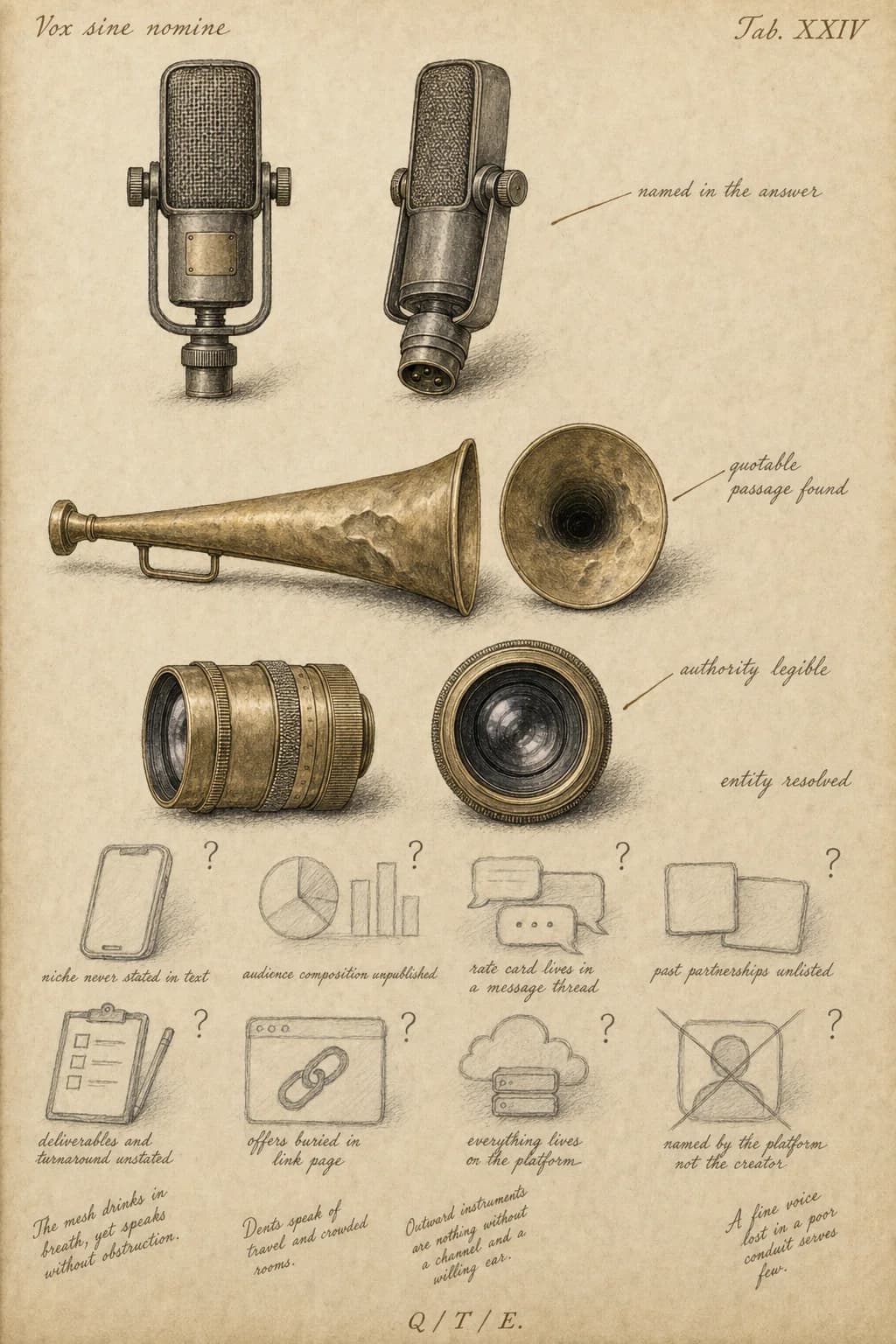
Over three million channels are enrolled in the YouTube Partner Program, and 35 percent of brand and agency buyers with real creator budgets are already using AI in creator selection. A creator being sorted out of a field that size is being sorted on documented facts. Niche, audience, rates, past work, and what is actually for sale usually exist only inside a platform, where a model cannot reach them. A margin note on the plate reads: A fine voice lost in a poor conduit serves few.
One question, four lanes
A model does not answer a question. It breaks the question apart, answers each piece from whatever it can read, and reassembles the result. Here is what happens when a brand goes looking for a creator.
The AI visibility gap
The field is enormous and the selection is being handed to software.
Two numbers frame the problem. One counts the channels in the field. One counts the buyers already routing creator selection through AI. Both are named honestly on the right, and the second matters for what it does not claim.
3 million
channels are enrolled in the YouTube Partner Program.
YouTube, "Second chances on YouTube," October 2025. Platform administrative count of channels currently enrolled in the YouTube Partner Program as of publication. YouTube does not publish the underlying count method, deduplication rules, or activity window. Enrollment enables monetization and does not establish that a channel is actively publishing or currently earning. The unit is channels rather than people, and one creator can operate several.
35%
of brand and agency buyers running creator campaigns say they currently use AI for creator selection.
Interactive Advertising Bureau with Advertiser Perceptions, "Creator Economy 2025: Ad Spend & Strategies," November 2025. n=453 advertising decision makers at brands and agencies, screened to at least $1 million in 2025 ad spend and at least $100,000 in creator marketing spend. Fielded July 28 to August 12, 2025. Question asked how respondents currently incorporate AI into creator campaigns, multiple response. Measures current behavior. IAB is a trade association and Advertiser Perceptions is an independent research firm, neither sells creator matching software. The report does not distinguish general purpose AI assistants from AI features built into influencer marketing platforms, so this figure establishes that AI is used in creator selection and does not establish which tools.
A note on the figures
The second source line matters more than the number. IAB did not ask which AI, so this does not prove buyers are using ChatGPT to pick creators. It proves the selection step is being handed to software that works from documented facts. A creator with nothing written down off platform loses that step either way.
What the model cannot read about your work
Three reasons AI doesn't name you.
GAP 01
Your storefront is rented and your facts are inside it.
The subscriber count, the watch time, the audience breakdown, the archive that proves what you cover. All of it is real and all of it lives inside YouTube, Substack, Patreon, or Spotify. A model answering a question about creators in your niche is working from the open web, where a link page and a bio line are often the entire record. The platform knows exactly who you are. Nothing outside it does.
GAP 02
Niche is demonstrated, and demonstration is not retrievable.
Four years of home espresso video establishes a niche to any person who watches ten minutes of it. It establishes nothing to a system that has not watched. Niche becomes retrievable when it is written as a sentence, attached to a name, and published somewhere a model can quote. The body of work is the evidence. The sentence is what makes the evidence findable.
GAP 03
The buyer side already knows this is broken.
In the same IAB research, a third of creator marketing buyers named identifying the right creators as their biggest hurdle, and a quarter said discovery and vetting tools were what they most needed to improve creator marketing. The people with budgets are telling researchers they cannot find who they are looking for. The creators they cannot find are findable, and are documented in places these buyers and their software do not reach.
Publish the business somewhere off the platform. What you cover, who watches, what you sell, what you charge, who you have worked with, written as facts at an address you own.
Where we work
Creators publish from anywhere to an audience with no map.
FAQ
Questions we get
My audience finds me through the platform algorithm. Why does search matter?
+
The algorithm serves people already on the platform. A model answers people who are not, including someone deciding what to get into and a brand building a shortlist before opening YouTube at all. Those are different rooms. The platform keeps doing what it does. This is about being findable in the room where the platform is not.
I work with an editor and sometimes a manager. Do you work with people already helping me?
+
We work through whoever is already helping you rather than around them. The people close to your work know things we would take months to learn, including which brands have approached you and what your audience actually asks for. Our job is to say what a model needs, work alongside them while the first pages exist, and then step back. The goal is that you can run this without us.
I am a newsletter writer, not a video creator. Does this apply?
+
The mechanism does not change with the format. A newsletter writer, a podcaster, a course creator, and a coach all have the same problem, which is that the work and the audience live inside a platform and the commercial facts are not written anywhere else. What is being documented differs. Where it has to live does not.
How do you know whether any of this worked?
+
We run the questions your audience and your potential partners actually ask, before and after, across the models they use. Whether you are named. Whether the answer places you in the right niche. Whether a stated constraint like format, audience, or partnership history pulls you into the answer. Here is how we measure whether models name you.
Publishing my rates feels like a bad idea. Is that required?
+
No. A range, a starting point, or a plain statement that you do partnerships and how to ask is enough for a model to place you in a shortlist. The thing that hurts is silence, because a system with no pricing signal at all has nothing to match against a budget. What you disclose is your call and there is room between a public rate card and nothing.
I already have a website and it does not seem to do anything.
+
A creator site is often a bio, a photo, and links out. That is a business card. What a model needs is the specifics: what you cover, what formats you work in, who watches, what you sell, who you have worked with, how to reach you. The site is not the problem. What is on it is.
What does this actually look like for someone working solo?
+
Mostly writing, and less of it than you would expect. A page that states your niche in plain language. A page for what you sell, whether that is a course, a membership, or partnerships. A page listing work you have done with brands. Audience described in facts rather than adjectives. Structured data connecting you as a person to the work and the offers. Then the slower part, which is getting that description corroborated where a model already looks, including podcast directories, guest appearances, and coverage you are already part of.
Start with a read on where you stand.
The Context Map is a fixed-scope diagnostic that shows how AI search treats you and your work in your niche.