AI Search Optimization for SaaS
Buyers ask AI to compare tools in your category. It names a dozen, and not always you
Ask an assistant to compare tools in a category and it returns a slate, usually a dozen names, assembled from the job, the use case, and the integrations the buyer described. The buyer reads the slate before they ever visit a vendor site. In software that slate runs wide, a median of around thirteen names for a buyer question, and which names appear shifts from one run to the next. Being in the category does not get you named. Being named once does not get you named on the next run.
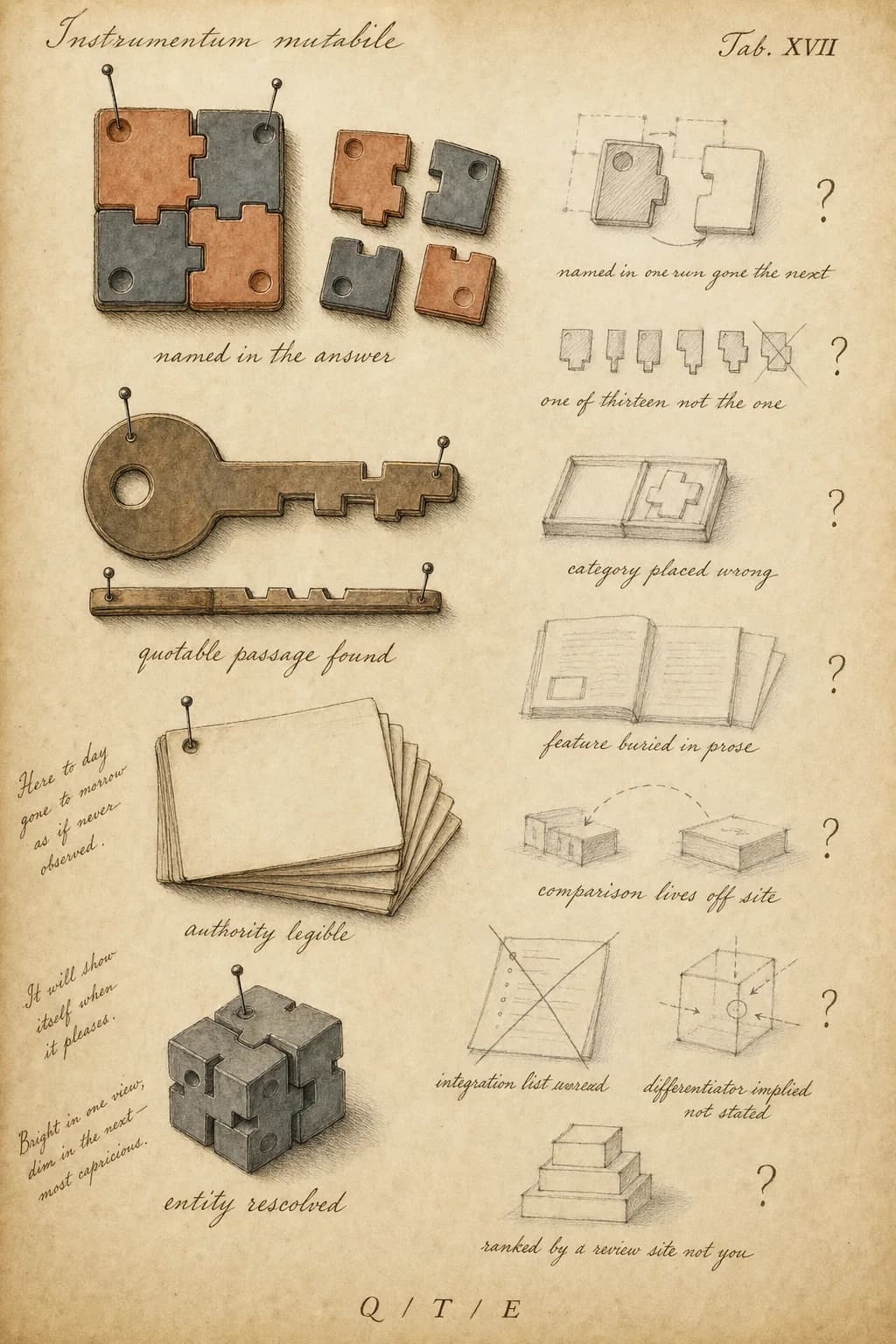
The confirmed specimens are the facts an assistant has tied to your tool and will name in an answer. The unresolved sketches are why a software vendor appears in one answer and vanishes from the next, a category placed wrong, a differentiator written as a mood instead of a fact, a comparison that lives on a review site instead of yours. In a category where the model names about a dozen tools and the list shifts run to run, the margin note holds: bright in one view, dim in the next, most capricious.
How AI search works
The AI visibility gap
AI names a slate, and the slate keeps moving.
Software is the widest category the assistants answer. Ask for a tool and the model returns a slate of names rather than one winner, and the names shift from one run to the next. The two figures on the right measure how wide the slate runs and how far into the buying process the assistant reaches.
The vendors named reliably get considered every time a buyer asks. The ones named once and dropped the next run are present on paper and absent in practice, because the buyer only sees the run in front of them.
13
the median number of brands AI names per software buyer question. Software is the least concentrated category studied, so the list is wide and it rotates.
Parse, "AI names one winner in consumer categories and a dozen in software," June 2026. 631,087 brand recommendations across 10,839 buyer questions, ChatGPT and Google AI Overviews, October 2025 to April 2026. Vendor research: Parse sells AI-search intelligence.
94%
of B2B buyers used AI assistants during their buying process, with use peaking mid-journey to compare offerings and synthesize vendor information.
6sense, 2025 B2B Buyer Experience Report. n=3,744 B2B buyers. General B2B, not SaaS-specific.
Why AI skips your tool
Three reasons AI doesn't name your tool.
GAP 01
The list is wide, and you are competing to be on it at all.
In software the model does not name one winner. It names a slate, around a dozen tools for a category question. Everything outside that slate is not losing the comparison. It is not in it. The first job is making the set, before position inside it matters.
GAP 02
You get named in one run and dropped in the next.
Which tools appear shifts from one answer to the next, even for the same question. A vendor named in a third of runs is absent from the other two thirds. Showing up once is not presence. Presence is showing up when the buyer asks, every time they ask.
GAP 03
Your difference is written as a mood, not a fact.
We are the fastest, the most loved, the leading platform. The model cannot cite a mood. It can cite what you integrate with, what you do that a named alternative does not, which use case you fit. The vendor whose difference is a checkable fact gets named. The one whose difference is an adjective does not.
The category names a dozen tools and the list keeps moving. Being on that slate reliably, for the questions your buyers actually ask, is what this comes down to. The list keeps moving; the goal is to keep appearing on it.
Where we work
Software sells worldwide. Your entity still lives at one address.
FAQ
Questions we get
Buyers still find us through review sites and referrals, not ChatGPT. Why does this matter?
+
Both are happening at once. Review sites and referrals still work, and buyers now also open an assistant and ask it to compare tools in your category before they get that far. When they do, the model names a slate of vendors, a median of around thirteen for a software question, and the ones it does not name are not in the conversation. The review site still matters. The problem is the buyer who starts by asking AI which tools to even look at, and never sees you because you were not in the set it returned.
We have a marketing team, but they run demand gen and content, not this. Do you work with existing teams?
+
Yes, and that is the usual shape of it. Most SaaS companies we work with have a capable marketing team running demand gen, content, and paid, and none of them has had a reason to learn how AI answers get assembled yet. We work through your team, not around them. We do the parts that need the specialized knowledge, entity structure, comparison and feature content the model can read, and measurement, and we hand back the reasoning so your people can carry it. The goal is that your team can run this without us.
AI names a dozen tools in our category anyway. Isn't being one of them enough?
+
Not on its own, because the list is not stable. In software categories the model tends to name a wide slate rather than a single winner, and which names appear shifts from one run to the next. A vendor who shows up in a third of answers is absent from the other two thirds, even though they technically appear. The work is not getting named once. It is getting named reliably, so that a buyer asking the same kind of question next week still sees you.
How do we know if any of this moved?
+
We build a set of category and comparison queries the way your buyers actually ask them, the job to be done plus the constraints plus the integrations, and run them across the assistants on a schedule. Then we track whether you appear, how often across repeated runs, in what position, and against which competitors. The measure is not traffic. It is reliable presence in the answer for your category. Here is how we measure whether AI names you.
Our differentiation is all over our site and our decks. Isn't that enough for the model?
+
Usually not, because of where it lives and how it reads. Differentiation written as marketing prose, we are the fastest, the most loved, the leading platform, gives the model little it can attach to a specific buyer question. What it can use is concrete and checkable: what you integrate with, what you do that a named alternative does not, which use case you fit. The model recommends the vendor whose difference is stated as a fact it can cite, not the one whose difference is stated as a mood.
We're early stage, not a category leader. Is this only for established vendors?
+
Early stage can be an advantage here. The model is not only naming the biggest vendor, it is assembling a slate, and a specific tool that clearly fits one use case for one kind of buyer is easier to place than a large platform that claims to do everything. Being the clear answer to a narrow question gets you named. You do not have to outrank the leader. You have to be legibly the right fit for a question the leader answers vaguely.
How long before an assistant reliably names us?
+
Structural fixes show up in retrieval within weeks, once your category, your integrations, and your differentiators live in text the model can read and cite. Reliable presence, the model naming you across repeated runs rather than intermittently, builds over months, because it depends on third-party sources and comparison content catching up. Watch presence first, whether you appear at all for your core category queries, then stability, whether you show up every time or only sometimes.
Start with a read on where your tool stands.
The Context Map is a fixed-scope diagnostic that shows how AI search names your category, and whether it names you.