AI Search Optimization for Agritourism
Visitors ask AI for farm tours and your farm shows up as a crop
Your farm is documented. The coffee, the acreage, the harvest, the certifications, all of it sits in text a machine can read. The visit does not. The tour runs every Saturday and lives in a text thread, a phone call, and the memory of whoever answers the gate.
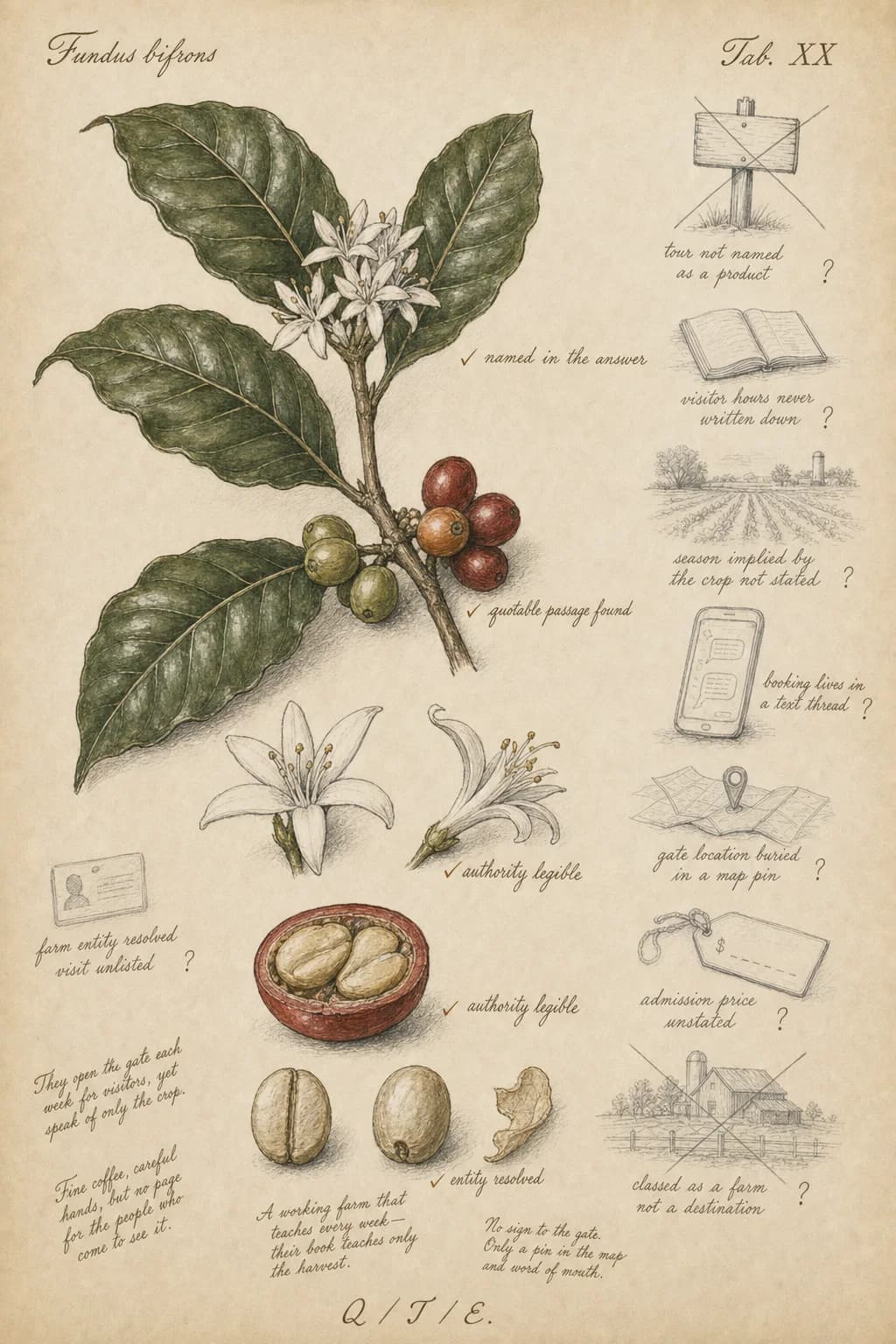
The farm resolves cleanly as an agricultural entity. The visit does not resolve at all. AI systems answer from what a business has written down in text a machine can read, so a coffee operation with a documented harvest and an undocumented tour gets named for its crop and passed over for its visitor experience. A margin note on the plate reads: Fine coffee, careful hands, but no page for the people who come to see it.
One question, four lanes
A model does not answer a question. It breaks the question apart, answers each piece from whatever it can read, and reassembles the result. Here is what happens to a farm visit query.
The AI visibility gap
The farm is documented. The visit is not.
Two numbers frame the visit. One counts the farms already earning it. One counts the travelers now planning with AI. Both are named honestly, and neither is agritourism-specific.
28,617
US farms and ranches earned income from agritourism and recreational services in 2022, totaling $1.26 billion.
USDA Economic Research Service, "2022 Census of Agriculture: The majority of U.S. counties generate some agritourism income," December 2024, drawing on the 2022 Census of Agriculture from USDA National Agricultural Statistics Service. Complete-count census design, 61 percent response rate, capture-recapture adjustment for undercoverage and nonresponse. Observations cover calendar year 2022. The reported category combines agritourism with recreational services including hunting, fishing, and on-farm lodging, so it cannot be narrowed to farm tours alone.
16.8%
of American travelers used AI tools to help plan or prepare for a trip in the past twelve months.
Future Partners, "The State of the American Traveler," May 2025 wave, fielded April 16 to 22, 2025. n=4,122 US adult travelers, weighted by Census region, confidence interval plus or minus 1.55 percent. Measures past behavior, not stated intent. General trip planning, not agritourism-specific and not broken out by activity discovery. Independent tourism research firm. Panel provider and full weighting variables are not publicly disclosed.
A note on the figures
Sixteen point eight percent is a behavioral number. Future Partners asked 4,122 travelers whether they had used AI to plan a trip in the past twelve months and 16.8 percent said yes. Higher figures circulate in travel research, and the ones we checked asked whether people intended to use AI rather than whether they had. Intent and behavior are different measurements and this page uses the smaller one. A farm that cannot be found by the sixteen percent also cannot be found by the sixty percent when that arrives.
What the model cannot read about your farm visit
Three reasons AI doesn't name your farm visit.
GAP 01
The farm resolves. The visit does not.
Ask a model about your farm and it will answer. It knows the crop, the district, the acreage, sometimes the certifications and the awards. That information has been written down for decades by extension offices, ag departments, cooperatives, and the farm itself. The visitor business is newer and has never been written down anywhere in the same way. The model has resolved you as an agricultural entity and has no reason to think of you as a place someone goes.
GAP 02
The tour is real revenue and is not named as a product.
A tour with a name, a duration, a price, a start time, and a booking path is a thing a model can retrieve and quote. A tour that exists as a sentence on an About page saying visitors are welcome by appointment is not. Ranch tours, u-pick afternoons, tastings, and farm stays each need to exist as their own documented offering. USDA counted 28,617 farms earning this income in 2022. That count exists because the government asked. Nothing comparable asks whether the visit is written down anywhere a model can read, which is its own answer.
GAP 03
The answers to the real questions live in conversation.
What is ripe in March. Whether the path is stroller friendly. Whether the tour runs when it rains. Whether children under five are free. Whether the road in needs four wheel drive. Every farm answers these questions ten times a week on the phone and in a text thread. None of it is on a page. A model asked to compare farms for a family with a toddler has to work from what it can read, so it recommends whoever wrote it down.
None of this is complicated and none of it is fast. It is writing down a business that has run on conversation, then making the model read the farm and the visit as two things instead of one.
Where we work
A farm visit happens where the farm is and nowhere else.
FAQ
Questions we get
Our farm already ranks well on Google. Why does this matter?
+
Google sends people to a page and lets them decide. An AI answer decides first and names two or three farms. Those are different jobs and they read different things. Search ranking rewards a page that has been optimized. An AI answer rewards a business whose facts are written down plainly enough to be quoted. A farm can hold the top Google result for its district and still be absent from the answer a visitor gets when they ask which farm to actually go to.
We already have someone who runs our website and our social. Do you work with existing teams?
+
We work through your team, not around them. Whoever runs your site already knows things about your operation we would take months to learn, including what visitors actually ask at the gate and which questions come up every single week. Our job is to tell them what the model needs, sit with them while the first pages get written, and then leave. The goal is that they can run this without us. If we are still necessary in a year, something went wrong.
We are a working farm first. Will this turn our site into a tourism site?
+
No. The farm identity is an asset and it is already resolved. What is missing is a second identity sitting alongside it. A coffee farm that documents its harvest and its tour separately gets retrieved for both. A coffee farm that documents only the harvest gets retrieved for one. Nothing about the agricultural side gets diluted by writing the visitor side down.
How do you know whether any of this worked?
+
We run the questions your visitors actually ask, before and after, across the models they use. Whether the farm is named. Whether the tour is named as a product. Whether the answer carries your hours and your season. Whether a constraint like accessibility or young children pulls you into the answer or leaves you out of it. Here is how we measure whether the visit shows up.
Our tour is seasonal. Does that break this?
+
Seasonality helps once it is written down. A model asked what is happening on farms in March has almost nothing to work from, because farms describe their season in terms a machine cannot convert into dates. Writing down what is ripe when, what the tour looks like in each season, and what happens in the off months gives the model something to match against a visitor asking about a specific week.
We take bookings by phone and text. Do we need a booking system?
+
Not to start. What matters first is that the price, the duration, the start times, and the way to reach you exist as text on a page. A phone number that a model can read and quote is worth more than a booking widget it cannot see. A booking system helps later, and it helps most when the tour is already documented well enough that people arrive looking for it.
What does this actually look like for a farm our size?
+
Mostly writing. A page for each thing a visitor can do, with the details that get asked on the phone. Hours and season stated in a form a machine can parse. The farm and the visit described as two connected entities rather than one. Structured data that says this is an agricultural business and also a place that receives guests. Then the slower work of getting that description corroborated in places the model already trusts, which for farms usually means extension listings, ag department directories, and cooperative pages you are probably already in.
Start with a read on where your farm visit stands.
The Context Map is a fixed-scope diagnostic that shows how AI search treats your farm and your visit in your market.