AI Search Optimization for Manufacturers
You do the work buyers ask AI for. It sends them to a competitor
A procurement team looking for a supplier does not start with a list of shops anymore. They describe the job to an assistant, powder coating for OEM parts, fabrication at volume, a coating line near the plant, and the assistant hands back a few names. Those names get the RFP. If the model does not connect your shop to the capability they searched for, you are not losing the bid. You are never asked to quote it.
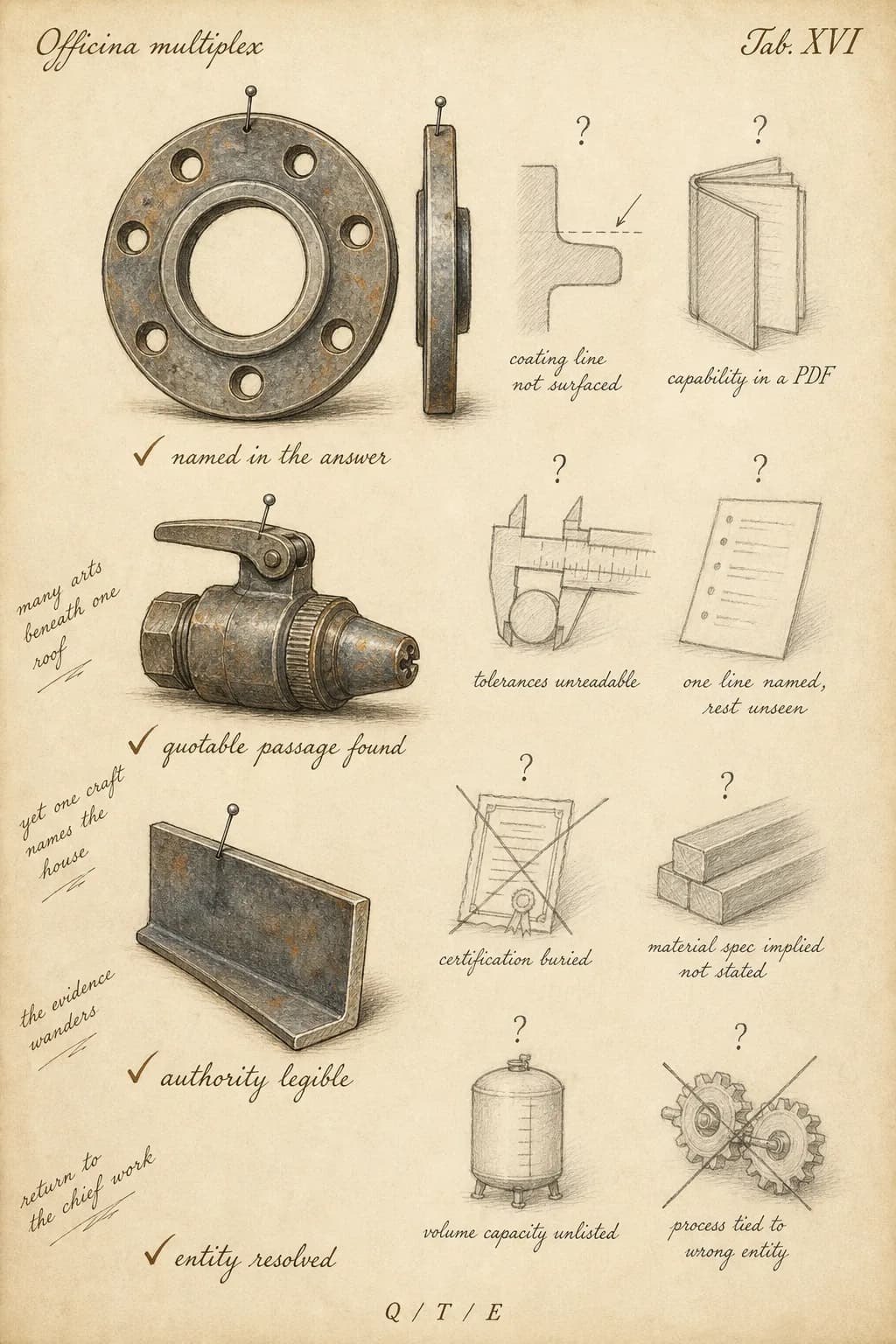
The confirmed specimens are the capabilities a model has tied to your shop and will name in an answer. The unresolved sketches are the capabilities it cannot read, buried in a PDF, implied in a spec, or attached to the wrong entity, so a buyer searching for that work never finds you. The margin note reads: many arts beneath one roof, yet one craft names the house.
How AI search works
The AI visibility gap
Your buyers brought AI into the sourcing decision.
The sourcing search now often starts inside an assistant. A buyer describes the job, reads back the names that come out, and builds the shortlist from there. The two surveys on the right measure how far that shift has already gone.
Shops the model already ties to the work compound that position every time a buyer asks who can do the job. Shops it cannot read lose bids they never see, because the shortlist was set before the phone rang.
37%
of technical buyers use generative AI at least sometimes to evaluate or make a work purchase. Only 31% never do.
GlobalSpec, TREW Marketing, and Elektor, 2026 State of Marketing to Engineers. n=751 engineers and technical buyers evaluating work purchases.
55%
of business buyers use AI to compare products during the buying process.
Forrester, Buyers' Journey Survey 2025. More than 17,500 global business buyers. General B2B, not manufacturing-specific.
Why AI skips your shop
Three reasons AI doesn't name your shop.
GAP 01
The buyer searches for a capability, not a company.
Procurement does not type your name. They type the job: the process, the material, the volume, the spec. Retrieval hands back the shops the model has firmly tied to that job. If it has not tied you to it, you are not in the set that gets considered.
GAP 02
What you can do lives where the model can't read it.
Tolerances in a capabilities sheet. Materials and processes in an equipment list. Certifications in a downloadable spec. That is where a buyer's real question gets answered, and it is the part of your site retrieval cannot parse.
GAP 03
You get named for one line and forgotten for the rest.
A shop that does coating, fabrication, and assembly gets tied to whichever line has the most public footprint. A buyer who needs one of the others never learns you offer it, because to the model you don't.
Every version of this is the same gap. The model has to connect your shop to the work before a buyer searching for that work can find you.
Where we work
Buyers source by capability first and location second. We cover both.
FAQ
Questions we get
Our buyers find us through RFPs and referrals, not ChatGPT. Why does this matter?
+
The RFP is still where the award happens. What changed is who gets on the list that receives it. Procurement and sourcing engineers now run an early research step before the RFP goes out, and a growing share of that step happens inside an assistant. If the model does not surface you when they describe the job, you are not on the list that gets asked to quote. The referral still works when it happens. The problem is the buyer who has no referral and starts by asking AI who can do the work.
We have an internal marketing team and a web person. They're out of their depth on AI. Do you work with existing teams?
+
Yes, and that is the usual shape of it. Most manufacturers we work with have a capable marketing person and someone who owns the site, and neither has had reason to learn how retrieval and AI answers work yet. We work through your team, not around them. We do the parts that need the specialized knowledge, entity structure, capability content, and measurement, and we hand back the reasoning so your people can carry it. The goal is that your team ends up able to run this themselves, not dependent on us to keep it running.
We do a dozen processes. Does the model really only know one?
+
Usually, yes. A shop that runs coating, fabrication, and assembly tends to get tied to whichever line has the most public footprint, the one with the most pages, the most mentions, the clearest story. The model builds its picture of you from what it can read, and if eleven of your twelve processes live in a capabilities PDF or a single line on an overview page, they carry almost no weight. You know you do all twelve. The model knows the one you happened to write the most about.
How do we know if any of this moved?
+
We build a set of capability queries the way your buyers actually phrase them, the process plus the material plus the spec, and run them across the assistants on a schedule. Then we track whether you surface, for which capabilities, and against whom. The measure is not traffic. It is presence in the answer for the work you do. Here is how we measure what the model knows you can do.
Our capabilities are all in downloadable spec sheets. Is that a problem?
+
It is one of the most common ones. A capabilities PDF, an equipment list, a tolerance table, a certifications sheet, these hold the exact detail a buyer's question turns on, and they are the part of your site retrieval reads least well. The fix is not to delete the PDFs. It is to make the same facts exist in text the model can parse, on pages built around the capability rather than buried in a download. The spec sheet stays for the human. The plain-text version is what gets you retrieved.
We're a small job shop, not a tier 1. Is this only for big suppliers?
+
Small shops often do better here. Retrieval rewards a clear, specific match to a specific question, and a shop that does two processes well for one kind of part is easier to tie to those processes than a large supplier who does everything for everyone. Scale buys footprint in traditional search. It matters less in a system looking for the cleanest answer to a narrow capability question. If you are the obvious answer to "who does X for Y," size is not what decides it.
How long before an assistant lists all our capabilities correctly?
+
Structural fixes show up in retrieval within weeks, once the capability lives in text the model can read and the pages are built around the work rather than the company. Entity accuracy, the model reliably tying every line to your shop, moves over months, because it depends on third-party sources catching up to what you actually do. Watch presence first, whether you surface at all for a capability, then accuracy, whether the answer describes everything you offer rather than one line.
Start with a read on where your shop stands.
The Context Map is a fixed-scope diagnostic that shows how AI search treats your shop in your market.