AI Search Optimization for Aviation
Someone asks AI which operator to trust and your certificate is the only thing about you that is written down
Charter, flight training, maintenance, avionics, management, brokerage. Your certificate says you are legal. It says nothing about what you fly, where you are based, which ratings you teach, or what your shop is actually good at. The FAA lists 1,837 Part 135 certificate holders alone.
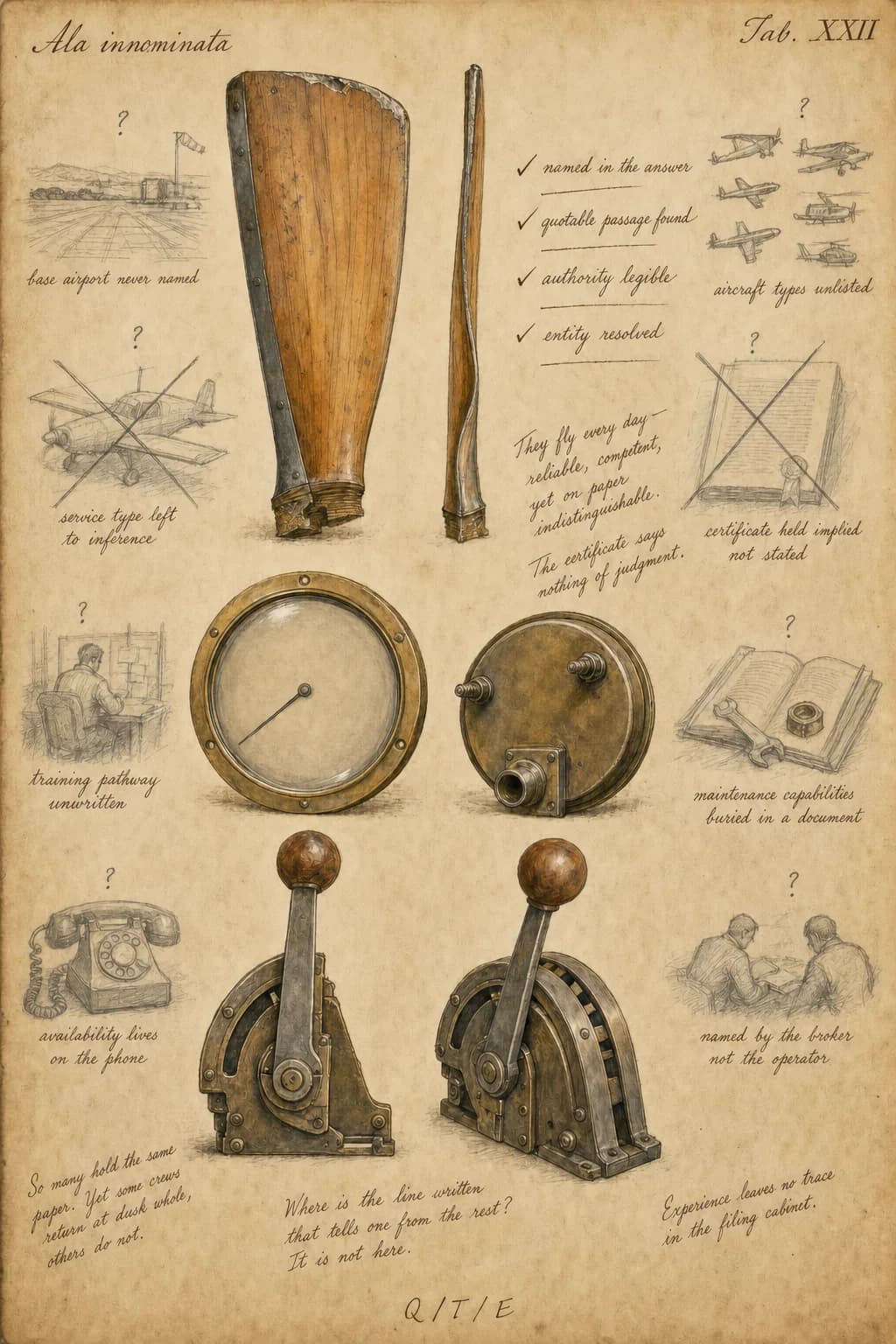
The FAA lists 1,837 Part 135 certificate holders. Holding the certificate is the entry requirement and says nothing about what an operator actually flies, where it is based, or what it is good at. A buyer asking a model to narrow that field gets whichever operators wrote those facts down. A margin note on the plate reads: Experience leaves no trace in the filing cabinet.
One question, four lanes
A model does not answer a question. It breaks the question apart, answers each piece from whatever it can read, and reassembles the result. Here is what happens to an operator sourcing query.
The AI visibility gap
Every operator holds the certificate. It tells a buyer nothing.
The field is large and the public record is thin. A buyer asking a model to narrow it gets the operators who wrote down what they fly, where they are based, and what they are good at. The rest hold the same paper and stay indistinguishable.
1,837
Part 135 certificate holders listed by the FAA, operating 11,582 authorized aircraft.
Federal Aviation Administration, "Safe Air Charter," accessed August 2026. Administrative count of Part 135 certificate holders and aircraft authorized under those certificates, drawn from FAA certificate records. The page does not publish an as of date or a refresh schedule, so the vintage is stated as accessed. Part 135 covers cargo, air ambulance, and commuter operations alongside on demand passenger charter, so the count is not a count of passenger charter competitors.
A note on the figure
One number instead of two. The second card would normally carry research on how aviation buyers use AI to find operators. We looked for it across FAA, NBAA, AOPA, ARSA, NATA, and the trade press and did not find it. What we found instead is below.
What the model cannot read about your operation
Three reasons AI doesn't name your operation.
GAP 01
The certificate is the entry requirement and it is the whole public record.
Every operator in the field holds one. It establishes that you are legal to fly, teach, or turn wrenches. It establishes nothing else. What aircraft you actually operate, which airports you are based at, which ratings you teach and on what equipment, which airframes your shop is rated for, what you handle that the operator down the ramp does not. A buyer needs those facts to choose. A model needs them written down to offer you.
GAP 02
The association is telling buyers to use AI. The operators have not written themselves down.
In 2026 the National Business Aviation Association published guidance for flight departments on vetting potential vendors and recommended large language models as a research tool, naming GPT, Claude, and Copilot. That is the industry's own body instructing buyers to point a model at the operator field. The guidance does not measure whether they do it, and neither does anyone else. We went looking for research on aviation customers using AI to find providers and found a deep literature on aviation companies using AI to run themselves. Predictive maintenance, flight planning, crew scheduling, cockpit automation. On buyers finding operators, nothing.
GAP 03
Three different buyers, three different questions, one undocumented company.
A charter client asks who can fly a specific leg with a specific constraint. A flight student asks which school will take them from zero hours to a commercial certificate and how long it takes. An owner asks which shop is rated for their airframe and can take the aircraft this month. These are three unrelated searches landing on the same operator, and each one fails for the same reason. The answer lives in a phone call. A model cannot make the call.
Write the operation down with the specificity a buyer already uses on the phone. Fleet, base, ratings, capabilities, what you handle and what you send elsewhere.
Where we work
Every operator is based somewhere specific. So is the work.
FAQ
Questions we get
Our charter business runs on broker relationships. Does AI search matter for that?
+
It matters for the flights that do not come through a broker. Broker relationships are not at risk from an AI answer. Direct inquiries are a different channel, and they start with someone typing a question. When the operator is not documented, the broker stays the only path to you, and the broker is the entity that gets named. Writing down what you fly and where gives the direct channel somewhere to land.
We have someone handling our website and marketing already. Do you work with existing teams?
+
We work through your team, not around them. Whoever runs your site already knows things we would take months to learn, including which requests come in every week and which ones you turn away. Our job is to tell them what a model needs, work alongside them while the first pages get written, and then step back. The goal is that they can run this without us.
We are a flight school, not a charter operator. Does this page apply to us?
+
The mechanism is the same and the facts are different. A prospective student is choosing between programs on pathway, timeline, cost, aircraft, and whether the school can take them from where they are to where they want to be. Those facts are as absent from school websites as fleet details are from charter sites. The work is writing down the pathway with enough specificity that a model can match a student's stated starting point to your program.
How do you know whether any of this worked?
+
We run the questions your buyers actually ask, before and after, across the models they use. Whether the operation is named. Whether the answer connects you to the right service, the right base, and the right equipment. Whether a stated constraint like a mobility requirement, an airframe rating, or a training timeline pulls you into the answer. Here is how we measure whether buyers can tell you apart.
Everything about our operation is safety sensitive. Are you asking us to publish operational detail?
+
No. Nothing here requires publishing anything you would not already say to a caller asking whether you can take their trip. Fleet composition, base airports, ratings held, airframes serviced, and training pathways are commercial facts your competitors already know and your buyers already ask for. Security sensitive detail stays where it is.
Our fleet and availability change constantly. Do we have to keep a page current?
+
The facts that matter change slowly. Which aircraft types you operate, which airports you work from, which ratings and airframes you cover. Those hold for years. Live availability is a different problem and it does not need to be on a page. A model asked who can fly a leg is looking for who is capable of it, and capability is stable.
What does this actually look like for an operation our size?
+
Mostly writing. A page for each service you offer that states what it is, what equipment it runs on, and where. Base airports named. Ratings and capabilities stated as facts rather than implied by a certificate number. Structured data connecting the company to its services and locations. Then the slower work of getting that description corroborated where a model already looks, which in aviation usually means association directories, airport and FBO listings, and trade coverage you are already part of.
Start with a read on where your operation stands.
The Context Map is a fixed-scope diagnostic that shows how AI search treats your operation in your market.