The Concept
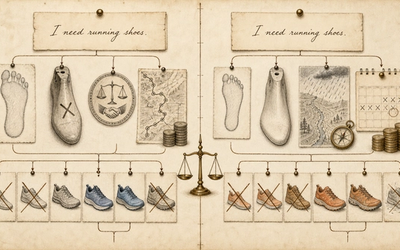
Entity resolution is the process by which an AI system decides whether multiple fragmented signals across the web belong to the same real-world identity. Models do not look for your brand name as a text string. They attempt to resolve a cluster of attributes (founding date, key personnel, product categories, schema identifiers) into a single verified node within their
knowledge graph. When those signals are consistent and anchored by high-authority sources, the model collapses the ambiguity and recommends your brand. When they conflict or dilute across common words and similar names, the
entity graph fractures. Confidence drops below the retrieval threshold. Your brand disappears, replaced by a competitor with a cleaner entity signature.
ELI5
Imagine you are trying to assemble a 1,000-piece jigsaw puzzle of a landscape without the box cover. If you find a blue piece, it could be the sky, the lake, or a reflection in a window. You can't place it confidently. But if you find a blue piece that also has a tiny corner of a red boat and the edge of a green dock, you know exactly where it goes.
If your brand only exists as a name on a page, the AI cannot tell it apart from everything else sharing that name. Give it specific, interlocking details everywhere your brand appears: exact location, category, official links. It places you correctly every time.
Practitioner Level
Entity resolution requires a shift from optimizing for keyword volume to engineering
entity consistency. Volume of mentions means nothing if the AI cannot resolve which entity is being referenced. Brands that improve their resolution rate typically do it by earning placements in publications AI systems already treat as authoritative.
The signals that matter:
Wikidata and knowledge graph entries, editorial coverage in high-authority publications, deep
schema markup on owned properties, and exact consistency across brand-owned channels. When a company's website, LinkedIn profile,
Crunchbase entry, and press materials describe the brand in the same terms, ambiguity during resolution drops. Inconsistency across owned channels is where resolution fails most often, including for brands with otherwise strong reputations.
The format of third-party mentions matters too. According to Wix Studio AI Search Lab research analyzing 75,000 AI answers, listicles capture 40% of commercial-intent citations across major LLMs, nearly double any other content type [1]. Cross-domain corroboration within these formats, meaning independent domains citing the same entity facts, produces the largest boost to resolution confidence.
One thing practitioners get wrong about citation data: they treat it as fixed.
Wikipedia dominates
ChatGPT citations.
Reddit leads on
Perplexity. YouTube leads on
AI Overviews. These are baselines, not permanent fixtures, and they are not uniform across verticals. What functions as the authoritative anchor in hospitality looks different from what anchors a cybersecurity brand. More importantly, citation concentration reflects current training data composition and retrieval index weighting. Both change with every model update and index refresh. Wikipedia is not cited because it is Wikipedia. It is cited because it is overrepresented in training corpora and crawled at high frequency. When that composition shifts, citation patterns shift with it. The practical move is not to chase the current top-cited domain. It is to identify what functions as the authoritative anchor in your specific vertical right now and build toward it, knowing the target moves.
The schema debate inside the SEO community is a category error worth naming directly. Most practitioners who have dismissed schema markup tested it for ranking lift, saw no movement, and concluded it does not work. That test measured the wrong outcome. Schema markup for entity resolution is not a ranking signal. It is
data sanitation. It reduces the computational cost of resolving your entity, which increases model confidence, which increases the probability you get cited. That causal chain does not show up in a rank tracker. No tool currently exists that accurately measures citation probability lift from schema implementation, which means the feedback loop SEOs rely on to validate tactics simply does not exist for this. The absence of a measurable signal is not evidence the tactic fails. It is evidence the instrumentation has not caught up to the behavior being optimized.
The Technical Layer
At the technical layer, entity resolution runs through three stages: detection, candidate generation, and disambiguation. The system detects potential entity mentions, generates a list of possible matches from parametric memory and retrieval index, then selects the best match by weighing surrounding context against established knowledge graphs.
Every resolution attempt burns computational cycles. When data is unstructured or inconsistent, the cost of
grounding the facts exceeds the system's limit. The model defaults to a competitor or hallucinates. Deep, nested
Schema.org markup (@id and sameAs properties specifically) pre-processes this data, shifting the burden from expensive deep
inference to fast knowledge graph lookups. Content is annotated at crawl time: chunks are classified and assigned confidence scores based on page-level topic, entity associations, and intent. If the page-level understanding is confused, every chunk annotation inherits that confusion.
The Parametric Conflict
Entity resolution fails two ways. First: absence of signals. The model cannot find enough corroborating data to resolve the entity. Second, and harder to fix: parametric conflict. The model has a confident but incorrect representation baked into its training weights [2]. For a full treatment of how the parametric and retrieval layers interact, see
Parametric vs. Retrieval Knowledge: When Models Answer From Memory.
According to Optimly's proprietary analysis of 5,829 brands, 59.8% of brand misrepresentation errors originate in the parametric layer [2]. This happens most when a brand pivots its category or rebrands, but its historical footprint dominates training data. When ChatGPT holds a strong parametric prior ("this company provides IT staffing") but live results say "cybersecurity," the model doesn't overwrite the prior. It weighs both. Conflict resolution in production systems is not deterministic and not documented by any platform. Based on architecture and published research on open-weight models, the parametric prior often wins: training crawlers process significantly more volume than search crawlers.
Fixing parametric conflict means more than updating a website. It means aligning authoritative third-party sources (Crunchbase, Wikipedia, G2) so the next training cycle ingests consistent signals and overwrites the stale weights. That is
entity SEO work, and it is the only lever that reaches the parametric layer.
| Feature | Google AI Overviews | Perplexity | ChatGPT |
|---|
| Primary Resolution Anchor | Google Knowledge Graph and deeply nested Schema.org markup | Live web retrieval, accessible schema, and well-structured product pages | Parametric training weights, editorial listicles, and high-frequency Reddit/UGC citations |
| Handling of Ambiguity | Relies on entity authority and semantic clarity; drops entities if comprehension cost is too high | Cross-references live sources; highly sensitive to clear on-page entity definitions | Weighs retrieved data against parametric priors; defaults to the most parametrically confident entity, even if incorrect |
| Index Source | Google's proprietary index and Knowledge Graph | Proprietary index combined with real-time web search | Bing's search index for real-time retrieval, layered over OpenAI training data |
| Key Optimization Lever | Comprehensive Content Knowledge Graph (CKG) with exact @id and sameAs mapping | Clear, structured technical documentation and consistent product specifications | Consistent entity descriptions across 15+ independent, authoritative sources to overwrite stale parametric priors |
Feature
Primary Resolution Anchor
Google AI Overviews
Google Knowledge Graph and deeply nested Schema.org markup
Perplexity
Live web retrieval, accessible schema, and well-structured product pages
ChatGPT
Parametric training weights, editorial listicles, and high-frequency Reddit/UGC citations
Feature
Handling of Ambiguity
Google AI Overviews
Relies on entity authority and semantic clarity; drops entities if comprehension cost is too high
Perplexity
Cross-references live sources; highly sensitive to clear on-page entity definitions
ChatGPT
Weighs retrieved data against parametric priors; defaults to the most parametrically confident entity, even if incorrect
Google AI Overviews
Google's proprietary index and Knowledge Graph
Perplexity
Proprietary index combined with real-time web search
ChatGPT
Bing's search index for real-time retrieval, layered over OpenAI training data
Feature
Key Optimization Lever
Google AI Overviews
Comprehensive Content Knowledge Graph (CKG) with exact @id and sameAs mapping
Perplexity
Clear, structured technical documentation and consistent product specifications
ChatGPT
Consistent entity descriptions across 15+ independent, authoritative sources to overwrite stale parametric priors
What Changed Recently
Two things shifted in March and April 2026. Google's March 2026 core update rolled out over 12 days starting March 27 [3]. In its wake, longitudinal Ahrefs data shows AI Overview citations from top-10 organic results dropped from 76% in July 2025 [4] to 38% in March 2026 [5]. Organic rank and AI citation likelihood are decoupling. Our read: structural optimization and
entity clarity are now required to bridge the gap.
Separately, ChatGPT citation behavior has split by model tier. According to Writesonic's citation analysis, the default model (GPT-5.3 Instant) sends 8% of citations to brand websites. The reasoning model (GPT-5.4 Thinking) sends 56% [6]. As reasoning models take more query volume, first-party entity clarity becomes a direct traffic variable.
The One Thing to Take Away
To survive in AI search, you must stop treating your brand as a text string to be ranked and start engineering it as a machine-readable entity to be resolved, using consistent signals, deep schema, and cross-domain corroboration to subsidize the AI's comprehension budget and overwrite stale parametric priors.
References