The vocabulary around AI search optimization is evolving. AEO, GEO, LLMO,
AI SEO. The terms overlap, the definitions shift depending on who uses them, and the industry has not settled on what any of them mean. Google recently published a guide saying AEO and GEO are just SEO. A lot of people agree. A lot do not.
Plate Lunch Collective does
traditional SEO and
AI search optimization. We use terms like AEO, GEO, and LLMO because we built specific, platform-level work around what each describes. We also do the foundational SEO work that makes any of it possible, and we do not treat the two as separate engagements. This piece explains the current landscape, where the evidence is strong, where it is thin, and how our practice sits inside all of it.
If you run marketing or SEO for a brand that depends on being discovered, the short version is: Google-only visibility is no longer sufficient, AI platforms cite differently from traditional search, and the measurement infrastructure for tracking any of it is still immature. The details follow.
How AI Platforms Retrieve Content
The important thing to understand is that these platforms do not share a retrieval system. Not a little different. Architecturally different.
Traditional search engines index web pages and rank them by relevance so a person can decide what to click. AI platforms do something else. They retrieve content, break it into passages, evaluate those passages for
factual density and source agreement, and feed them to a language model that synthesizes a response. The user often sees the answer without visiting the source at all.
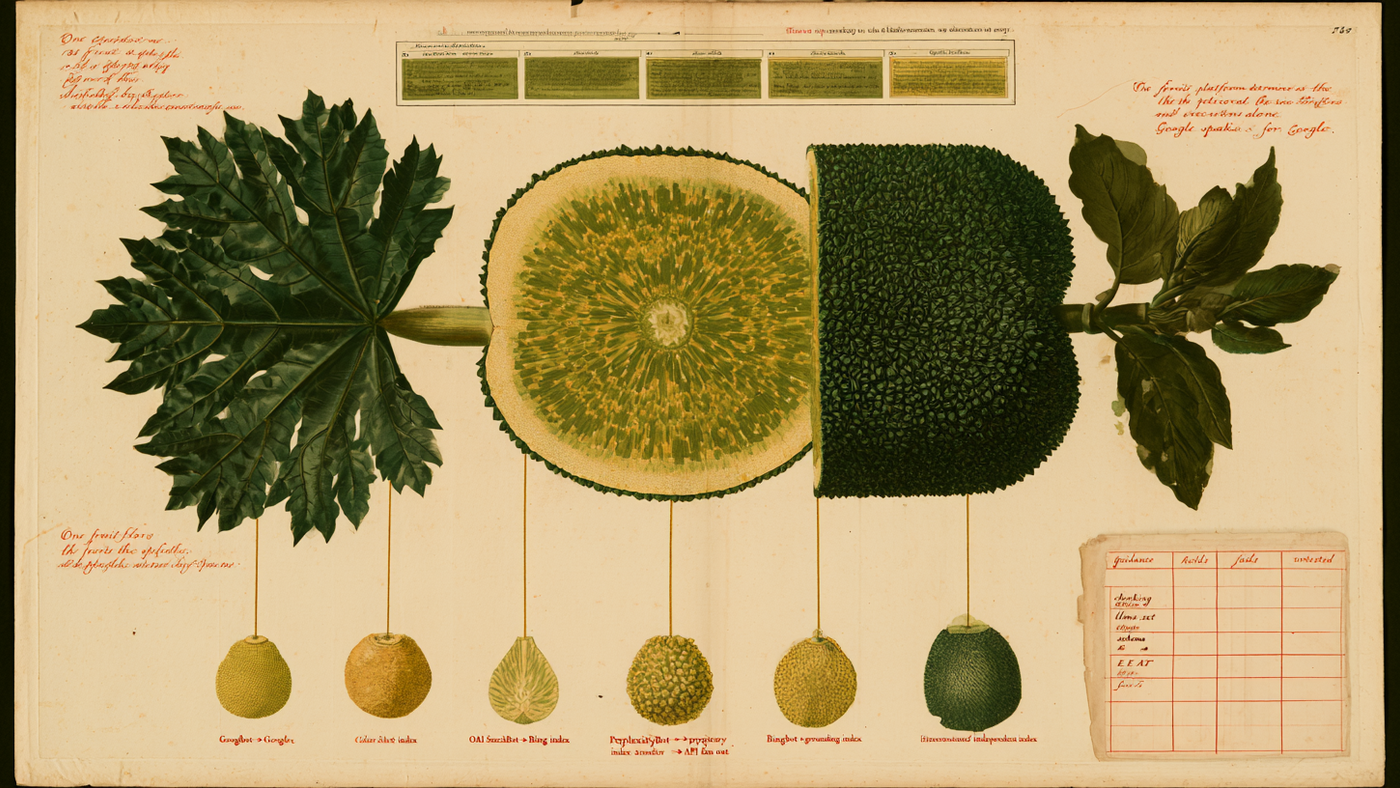
| Platform | Primary Index | Crawler(s) | Key Dependency |
|---|
| Google AI Overviews | Google Search | Googlebot | Google core ranking |
| ChatGPT Search | Bing + Proprietary | OAI-SearchBot, GPTBot | Bing index coverage |
| Perplexity | Proprietary (200B+) | PerplexityBot | Google & Bing APIs |
| Microsoft Copilot | Bing Grounding | Bingbot | IndexNow protocol |
| Claude | Brave Search | Anthropic-Control | Brave index coverage |
Platform
Google AI Overviews
Primary Index
Google Search
Key Dependency
Google core ranking
Primary Index
Bing + Proprietary
Crawler(s)
OAI-SearchBot, GPTBot
Key Dependency
Bing index coverage
Primary Index
Proprietary (200B+)
Key Dependency
Google & Bing APIs
Platform
Microsoft Copilot
Primary Index
Bing Grounding
Key Dependency
IndexNow protocol
Primary Index
Brave Search
Crawler(s)
Anthropic-Control
Key Dependency
Brave index coverage
Google
AI Overviews and AI Mode run on Google's core search index using Googlebot. Same ranking infrastructure as traditional search, different presentation layer.
ChatGPT Search runs primarily on Bing's index.
OpenAI operates its own crawler, OAI-SearchBot, for
real-time retrieval, and
GPTBot for broader data collection. If your site is well-indexed in Google but absent from Bing, ChatGPT Search cannot see it.
Perplexity runs its own crawler,
PerplexityBot, against a proprietary index of over 200 billion URLs while also querying Google and Bing APIs. It scrapes the top results and synthesizes in real time. Its citation behavior weights
Reddit and community discussion platforms heavily.
Microsoft Copilot is grounded in Bing's index. Bing's engineering team published a piece drawing an explicit distinction between traditional search indexing and what they call
grounding indexing. Their framing: traditional search indexing was built to help humans decide what to read. Grounding indexing is built to help AI systems decide what to say. Different goals, different architecture, even when they start from the same data.
Claude retrieves through Brave Search when web access is active. Different index entirely.
The platforms also show different editorial personalities in what they cite. BrightEdge (a vendor in this space, which is worth noting) found measurable differences in source type preferences across engines:
| Engine | Gov/Edu/Org Share | UGC Share | Sourcing Tendency |
|---|
| Gemini | 26% | 0.2% | Institutional, formal |
| Perplexity | 22% | 1.5% | Academic, research-oriented |
| ChatGPT | 18% | 0.5% | Established publishers |
| Google AI Mode | 14% | 7.0% | Broad commercial mix |
| Google AI Overviews | 10% | 18.0% | Forums, video, UGC-heavy |
Sourcing Tendency
Institutional, formal
Sourcing Tendency
Academic, research-oriented
Sourcing Tendency
Established publishers
Sourcing Tendency
Broad commercial mix
Engine
Google AI Overviews
Sourcing Tendency
Forums, video, UGC-heavy
Gemini cites government and institutional sources at 26%. Google AI Overviews, made by the same company, pulls 18% of its citations from user-generated content. Same parent company, different editorial behavior. "Optimize for Google" is not even a single instruction within Google's own ecosystem.
The Debate: New Discipline or Rebranded SEO
The industry has not settled this. Both sides have reasons for their positions.
The case that it is still SEO
Google's May 2026 guide states directly that AEO and GEO are still SEO from Google Search's perspective. Their
generative AI features are built on the same core ranking systems. Content that is well-structured, authoritative, crawlable, and useful is the content that performs well in AI features too. That makes sense for Google's systems.
The guide also pushes back on tactics agencies have promoted as essential: llms.txt files, deliberate content
chunking, seeded forum mentions, specialized AI
schema markup. Google says none of these matter for its systems.
And there is a real concern about agency economics driving the new terminology. Repackaging standard
technical SEO under new acronyms and selling it as a separate retainer is happening. The criticism has merit when the deliverables are indistinguishable from what a competent SEO program already produces.
The case that something is different
But the numbers tell a different story when you look beyond Google.
Researchers at Queen Mary University of London, Rutgers, and other institutions analyzed over 55,000 queries across six LLM search engines. They found that 37% of domains cited by AI platforms do not appear in traditional search results at all. Ahrefs analyzed ChatGPT's citation patterns and found only about 12% of the URLs it cites rank in Google's top 10. As of March 2026, over 60% of Google's own AI Overview citations come from outside the top 10 organic results, and that figure has grown more dramatic over time.
Those are not marginal discrepancies. If 37% of cited domains are completely absent from traditional search, and only 12% of ChatGPT citations overlap with Google's top results, then optimizing for Google and assuming AI visibility will follow is a strategy with a measurable gap.
The Princeton GEO study tested specific content optimization strategies across generative engines. Adding authoritative citations and statistical data increased source visibility by up to 115%, particularly for sites that did not dominate traditional rankings. Keyword stuffing decreased visibility. The study was peer-reviewed, funded by the National Science Foundation, and published through ACM SIGKDD. It is the strongest independent academic evidence that generative engines respond to different content signals than traditional search.
Google's guide is also, by its own framing, specific to Google. It does not claim authority over ChatGPT, Perplexity, Claude, or Copilot. Here is where that matters:
| Google's Guidance | Google | ChatGPT | Perplexity | Copilot |
|---|
| llms.txt unnecessary | Holds | Untested | Fails | Untested |
| Chunking redundant | Holds | Fails | Fails | Fails |
| No special AI schema | Holds | Holds | Holds | Holds |
| Quality & E-E-A-T matter | Holds | Holds | Holds | Holds |
| Inauthentic mentions fail | Holds | Holds | Holds | Holds |
| Google index is sufficient | Holds | Fails | Fails | Fails |
Google's Guidance
llms.txt unnecessary
Google's Guidance
Chunking redundant
Google's Guidance
No special AI schema
Google's Guidance
Quality & E-E-A-T matter
Google's Guidance
Inauthentic mentions fail
Google's Guidance
Google index is sufficient
Quality matters everywhere. That part of Google's guidance holds across the board. But the technical specifics, the claims about chunking, llms.txt, and index sufficiency, fail on three of four non-Google platforms. Perplexity actively parses structured Markdown. ChatGPT pulls 44% of its citations from the first third of a page, which means structure directly affects what gets cited. Copilot requires IndexNow for real-time freshness, a protocol Google does not support.
The search everywhere framing
Some in the industry have proposed consolidating all of this under "
Search Everywhere Optimization," the idea that SEO, AEO, GEO, and LLMO are facets of one integrated strategy. It is a useful slogan. It is not useful for planning.
Optimizing for Perplexity means working with its three-layer reranking system and its heavy
Reddit citation weighting. That work is irrelevant to ChatGPT, which retrieves through Bing's index and shows almost no Reddit dependency. Optimizing for Copilot means implementing IndexNow and ensuring Bing
index coverage. None of that matters for Google AI Overviews. The platforms are siloed at the infrastructure level, so treating them as one surface glosses over the decisions that actually determine whether content gets retrieved on each one.
How We Practice
We do traditional SEO. Site architecture, crawlability,
structured data, content strategy, technical health. Without it, nothing else works. 87% of ChatGPT citations come from URLs that already rank in search results. If your pages do not rank, they do not get retrieved.
We also do
retrieval layer optimization, which is where the platform-specific work begins. The terms we use map to specific workflow differences, not marketing categories.
What AEO means in our practice
Answer engine optimization is the structural work of making content extractable by
conversational AI systems.
Traditional search content is written for a person who reads a whole page. AI retrieval systems extract passages, typically 100 to 500 tokens, and evaluate them in isolation. If the useful information needs surrounding paragraphs to make sense, the passage does not get selected.
In practice: every section leads with its point in the first few sentences. Every heading and its opening lines function as a self-contained answer. BLUF formatting, bottom line up front. It is a different structural discipline from traditional SEO copywriting, which builds context before arriving at the answer.
What GEO means in our practice
Generative engine optimization is the platform-specific work of increasing citation probability across different generative engines. Each platform weights different signals.
The Princeton study found that adding authoritative citations and statistical data increased visibility by up to 115%. What we see in practice lines up with that. Content that contributes something the other ten pages on the topic do not have, whether that is
original data, specific numbers, named sources, or firsthand observation, gets cited more than content that comprehensively restates what is already available. Google's guide agrees with this, by the way. They call it "non-commodity content."
GEO also involves understanding how AI platforms discover content. Language models expand a single user prompt into multiple sub-queries, an average of 2.4 per prompt. About a third of cited pages get found through these sub-queries rather than the original prompt. Pricing details, technical specs, comparison tables, methodology descriptions. Content that would never rank for a traditional keyword gets retrieved because the model asked itself a follow-up question the page happened to answer.
What LLMO means in our practice
We use LLMO to describe
retrieval layer optimization broadly.
There is a theoretical second layer: parametric optimization, the idea of influencing what an LLM knows in its pre-trained weights. Worth understanding. Not something we sell.
| Retrieval Layer (RAG / Real-Time) | Parametric Layer (Training Weights) |
|---|
| Dynamic, query-time | Static, frozen at training |
| Pulls from live web indexes | Compressed from training corpus |
| Observable and influenceable | Opaque and unmeasurable |
| Platform-specific mechanics | Model-specific, no external visibility into weights |
| Measurable citation outcomes | |
| We focus here. | No one can directly optimize this. It is the long-term side effect of sustained authority. |
Retrieval Layer (RAG / Real-Time)
Dynamic, query-time
Parametric Layer (Training Weights)
Static, frozen at training
Retrieval Layer (RAG / Real-Time)
Pulls from live web indexes
Parametric Layer (Training Weights)
Compressed from training corpus
Retrieval Layer (RAG / Real-Time)
Observable and influenceable
Parametric Layer (Training Weights)
Opaque and unmeasurable
Retrieval Layer (RAG / Real-Time)
Platform-specific mechanics
Parametric Layer (Training Weights)
Model-specific, no external visibility into weights
Retrieval Layer (RAG / Real-Time)
Measurable citation outcomes
Parametric Layer (Training Weights)
Retrieval Layer (RAG / Real-Time)
We focus here.
Parametric Layer (Training Weights)
No one can directly optimize this. It is the long-term side effect of sustained authority.
The parametric layer is real. Models acquire knowledge during
pre-training by processing massive volumes of web text. A brand with extensive presence across
Wikipedia, major publications, industry databases, and active community discussions will likely appear in future training corpora. Over time, models "know" that brand without searching.
But no one has demonstrated a causal link between a content campaign and a change in a model's
parametric knowledge. The training pipelines are opaque, the filtration is aggressive, retraining cycles span months, and individual facts get diluted or lost during optimization. What people call parametric optimization is the long-term compound effect of building genuine authority across enough surfaces. It is a downstream result of doing retrieval layer work, traditional SEO, earned media, and brand building well for long enough. Real phenomenon. Not a distinct deliverable.
The Operational Differences
For a practitioner already doing high-quality SEO, the additions are specific rather than sweeping. Five things.
| Traditional SEO Workflow | Retrieval Layer Addition |
|---|
| Indexing for Googlebot | Multi-crawler provisioning |
| Keyword-targeted introductions | Answer-first (BLUF) formatting |
| Comprehensive topic coverage | Information gain assets |
| Keyword volume mapping | Query fan-out coverage |
| Backlink acquisition | Off-site entity and forum presence |
Traditional SEO Workflow
Indexing for Googlebot
Retrieval Layer Addition
Multi-crawler provisioning
Traditional SEO Workflow
Keyword-targeted introductions
Retrieval Layer Addition
Answer-first (BLUF) formatting
Traditional SEO Workflow
Comprehensive topic coverage
Retrieval Layer Addition
Information gain assets
Traditional SEO Workflow
Keyword volume mapping
Retrieval Layer Addition
Query fan-out coverage
Traditional SEO Workflow
Backlink acquisition
Retrieval Layer Addition
Off-site entity and forum presence
Multi-crawler provisioning. Making deliberate decisions about which AI crawlers get access. GPTBot, OAI-SearchBot,
ClaudeBot, PerplexityBot, Bingbot. Some are training crawlers, some are retrieval crawlers. The
robots.txt decisions around each are different. Get them wrong and you are invisible on a platform where you need to be visible, or handing training data to a system you would rather not feed.
Bing indexing and IndexNow. ChatGPT Search and Copilot both depend on Bing. A site that only submits sitemaps to Google may be poorly indexed in Bing and therefore invisible on AI surfaces that rely on it. IndexNow enables real-time index freshness for Copilot and Bing-dependent platforms. Google does not support it.
Content architecture for extraction. RAG systems extract 100 to 500 token chunks. If key information is buried in paragraph six, a human might get there. A RAG chunker probably will not. We had a hospitality client whose property details were distributed across long narrative pages. Restructuring those into standalone, passage-level sections with the answer in the first two sentences changed their citation profile on Perplexity within weeks. Our
citation-ready contentwork is built around this.
Information gain over information coverage. Traditional SEO rewards comprehensive guides. Generative engines filter redundant information. If a page says what ten other pages say, the RAG pipeline does not need it. It needs the one with
proprietary data, original numbers, or expert quotes the others lack.
Zero-volume query coverage. LLMs expand a single prompt into an average of 2.4 sub-queries. Nearly a third of cited pages are discovered through these sub-queries, which have zero traditional search volume. Pricing sheets. Technical specs. Methodology breakdowns. Comparison tables. Content that would never rank in traditional search but gets retrieved because the model asked itself a follow-up question the page happened to answer.
Off-site entity and social presence. AI engines use web-wide consensus to reduce hallucination risk. What others say about a brand matters as much or more than what the brand says about itself. Reddit mentions,
Wikidata entries,
Crunchbase profiles, G2 reviews, industry forum activity. This is not link building. It is entity consensus across the surfaces AI platforms actually check.
What Is Still Developing
The measurement infrastructure for AI search is not where it needs to be. A 2026 study by SparkToro and Gumshoe.ai had 600 people run identical prompts through ChatGPT, Claude, and Google AI nearly 3,000 times. The results:
| Metric | Value |
|---|
| Chance of identical brand list on any two runs | < 1% |
| Chance of identical list in the same order | ~ 1 in 1,000 |
| Minimum runs needed for stable visibility metric | 60-100 |
Metric
Chance of identical brand list on any two runs
Metric
Chance of identical list in the same order
Metric
Minimum runs needed for stable visibility metric
This does not mean optimization is pointless. Running the same prompt 60 to 100 times produces a statistically stable "visibility percentage," the share of runs where a brand appears anywhere in the response. The structural and authority work moves that number. But monthly reports showing a brand at "#2 in ChatGPT" are reporting a single draw from a probabilistic system. If your tracking vendor cannot tell you how many runs they average per query, ask. We published a
comparison of AEO monitoring platforms for anyone evaluating the current tooling landscape. For brands that want to understand where they currently stand before committing to a strategy, our
AI search visibility consulting starts with an audit across platforms.
The evidence base itself is developing unevenly. The Princeton GEO study is peer-reviewed and NSF-funded. Most other large-scale studies come from companies selling optimization tools: seoClarity, BrightEdge, SE Ranking, AirOps. Their research may be sound. The conflict of interest is consistent across the field and rarely disclosed. On the other side, SEO practitioners dismissing AEO and GEO as redundant have their own financial interest in the status quo. The incentives cut both ways and we think it is worth being transparent about that.
The platforms change their retrieval logic frequently. What Perplexity does with structured Markdown today may not be what it does in six months. ChatGPT's
retrieval pipeline has shifted multiple times since launch. Google's AI Mode is still rolling out. Building a 12-month playbook against platform mechanics that shift quarterly is risky. Building infrastructure that clients own and can adapt when the mechanics change is less risky. That is why we work in
90-day sprints rather than ongoing retainers. The volatility is not a problem to solve. It is the operating condition, and the engagement model should reflect it.
What This Means If You Run Marketing
You cannot assume Google-only visibility covers AI surfaces. If your site is not indexed in Bing, ChatGPT Search and Copilot cannot see it. That is not a theoretical risk. It is a binary gap.
If your content buries the answer in paragraph six, it is not getting retrieved. RAG systems extract passages, not pages. Structure matters on every platform except possibly Google, and even Google's own AI Overviews pull the majority of citations from outside the traditional top results.
If you are paying for monthly AI ranking reports, ask how many runs per query the tool averages. If the answer is one, you are looking at a lottery ticket, not a metric.
If your brand has strong organic rankings but weak entity presence across third-party platforms, you may be retrievable but not recommendable. AI engines check for consensus. What G2, Reddit, Wikidata, and industry forums say about you shapes whether the model trusts your content enough to cite it.
None of this requires a new agency or a new software stack. It requires understanding how each platform retrieves and doing the specific structural work that each one needs. Some of that work overlaps with what a good SEO program already does. Some of it does not. For organizations that need help prioritizing across these surfaces, our
fractional CMO engagements scope that work.
Where We Sit
Plate Lunch Collective is an
AI-native marketing consultancy. We do traditional SEO because it remains foundational. We do platform-specific retrieval layer optimization because the platforms require it. We use the evolving industry vocabulary because it maps to real differences in the work, not because the labels matter more than outcomes.
The landscape is early. The evidence is developing. The vocabulary will keep changing. Our
wiki tracks the terminology, the tools, and the research as it moves. Our
context mapping work maps the specific retrieval landscape for each client rather than applying a generic framework. Our approach is to stay close to the evidence, work at the platform level, and be straightforward about what we know and what we do not.