Back to Blog
AI SEOContext MapAI Search VisibilitySocial SearchAEOCitation-Ready Content
Retrieval Layer and Parametric Layer: The Two Systems That Determine AI Search Visibility

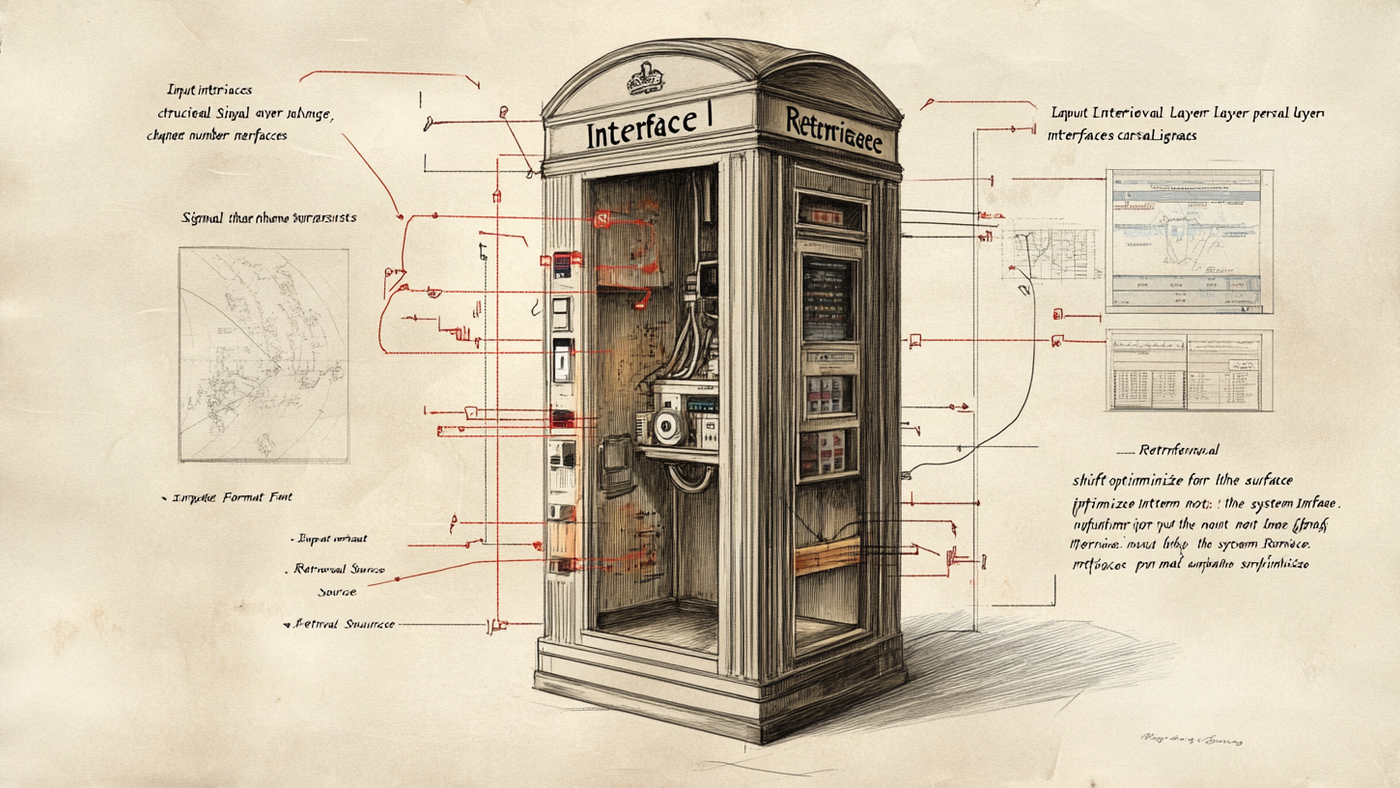
Why optimizing for retrieval without building parametric presence leaves most AI search responses unaddressed
Editor's note, April 2026: This piece was originally published in March 2025 under the title "The Retrieval Layer Strategy: One Optimization Approach for All AI Interfaces." The original argument was that retrieval layer optimization is the single strategy that works across all AI interfaces. That argument still holds, but it was incomplete. It addressed one of the two systems that determine what AI says about your brand and ignored the other. This revision adds the parametric layer, the system that determines what a model already believes about you before it retrieves anything, and updates every statistic to current sourcing. Claims we could not trace to a primary source have been removed.
How AI Changed Search Forever
It has been a while since I have seen anyone swipe a physical debit card instead of tapping it or their phone or smart watch on a payment terminal. Apple Pay launched in 2014 and only a handful of places accepted it. Now, using an actual debit card is starting to feel like writing a check. The same thing is happening, but at a much faster pace with traditional search and how information is discovered, processed, and delivered.
Only 37.4% of US Google searches now result in a click to the open web (SparkToro/Datos, 2024 Zero-Click Search Study). ChatGPT has surpassed 900 million weekly active users as of February 2026 (OpenAI). 157.1 million Americans are projected to use voice assistants monthly by 2026 (eMarketer). And smart glasses shipments surged 210% year-over-year in 2024, driven by Meta's Ray-Ban partnership (Counterpoint Research).
These are not separate trends. While most organizations scramble to optimize for each new interface as it emerges, they're missing the point. All these systems are drawing from the same well.
Google won so many people over as the search interface of choice. Now that dominance is fracturing. What comes next?
On Interfaces
I have hours and hours of memories of staring out large 70s era VW busses watching the rural and semi-developed landscapes of Ventura, Santa Barbara and San Luis Obispo counties scroll by like an infinite time lapse. Sometimes it would be one of the giant granite outcroppings of Yosemite that made you always look back over your shoulder to make sure the sky was still there. And summers in the Baja Peninsula where the desert met the ocean and the cardboard houses your mom's friend told you about looking nothing like they did in your imagination.
And other times it was riding down the street or on the bike path next to the beach on your off brand beach cruiser. Or discovering how the world looked through half a 40 oz next to a bonfire.
These interfaces all helped shape us and were grounded in the real world, like the 8-track player in the dash of those 70s VW buses. And now I find myself not staring out the window with John Denver playing, but trying to look into the future and see what happens when generative search and augmented reality replace the search box and the screen.
From Google Search to Everything Being Search
Traditional Search (2000-2020)
For two decades, information discovery was relatively stable. Users typed queries into search engines, received a list of links, and clicked through to websites. The optimization game was clear: rank higher in search results, get more clicks, drive more traffic.
This model created an entire industry around search engine optimization, with well-understood principles: keyword research, content creation, link building, technical optimization. The interface was consistent. A search box and a list of results. The optimization strategies were correspondingly focused.
Voice Gets Conversational (2020-2025)
Voice assistants evolved from simple command-response systems to capable AI-powered interfaces. eMarketer projects 157.1 million Americans will use voice assistants monthly by 2026, representing roughly half the population. The installed base of voice-capable devices globally exceeds 8 billion units (Juniper Research), though active voice search usage is a fraction of that number.
The accuracy improvements have been dramatic: modern voice recognition systems achieve accuracy levels that make voice a viable interface for complex information retrieval. Smart speakers command 44% of the voice commerce market (Grand View Research), while wearables represent the fastest-growing segment.
But the old voice assistants, Siri, Alexa, Google Assistant, never reached a truly conversational level. People spoke to them like a caveman. Short commands, simple lookups. The real shift is happening now with voice modes on ChatGPT, Gemini, Perplexity, MetaAI, and Claude, where users can ask longer questions in natural, often meandering language and get spoken answers back.
AI Chat Replaces the Search Box (2022-Present)
The launch of ChatGPT in November 2022 made it possible for users to have conversational interactions with AI systems, asking complex questions and receiving answers without ever visiting a website. Other platforms quickly followed: Google's Gemini, Anthropic's Claude, Perplexity's search-focused AI, and dozens of specialized AI assistants.
The numbers tell the story. ChatGPT surpassed 900 million weekly active users and 50 million consumer subscribers by February 2026 (OpenAI), with January and February 2026 tracking as the largest months for new subscribers in the company's history. Daily AI search usage in the US more than doubled from 14% to 29.2% between February and August 2025 (eMarketer), and eMarketer forecasts that 26.4% of the US population will be generative AI search users by the end of 2026.
The shift is not just new technology. It is a change in how people expect to get answers. McKinsey's October 2025 report found that half of consumers now use AI-powered search, a behavioral shift that stands to impact $750 billion in US revenue by 2028.
Social Media Becomes Retrieval Infrastructure (2023-Present)
Social media platforms are now part of the information retrieval infrastructure itself. This goes beyond AI-generated content on feeds.
TikTok's object recognition can identify items in videos and provide shopping links. Instagram's Meta AI analyzes images for shopping integration. YouTube's content ID system processes millions of hours of video content. With 5.22 billion social media users globally as of late 2024 (DataReportal) generating content that feeds AI training systems, social media has become a core component of the retrieval layer.
Augmented Reality Arrives (2024-Present)
The newest frontier in interface evolution is augmented and mixed reality. Meta's Ray-Ban smart glasses have surpassed 1 million units sold (confirmed by Mark Zuckerberg, January 2025) and drove global smart glasses shipments up 210% year-over-year in 2024 (Counterpoint Research). Apple's Vision Pro launched at $3,499 with more constrained adoption; IDC projected fewer than 400,000 units in 2024.
Counterpoint projects a sustained CAGR of over 60% for the smart glasses market through 2029. The AR/VR market overall is projected to grow from $46.6 billion in 2025 to $62.0 billion by 2029 (Statista). These interfaces don't just change how we input information. They change how we receive and interact with it.
On Optimization
Remember when Metallica sued Napster? The band was fighting the interface, not understanding that music consumption had already shifted. Then Apple launched the iPod and iTunes, legitimizing digital music but through a different interface. Then Spotify created yet another interface with streaming. Each time, the music industry had to choose: fight the new interface or adapt to it.
But here's what stayed constant through all those interface wars: music was still music. Whether you were buying CDs at Tower Records, downloading MP3s from Napster, purchasing songs on iTunes, or streaming on Spotify, the underlying content and the human desire to discover and consume it remained the same. The companies that thrived were those that optimized for music discovery and delivery, not those that optimized for any single interface.
Two Approaches to AI Optimization
There's a lot of money to be made in prolonging the problem. An entire consulting industry has emerged around treating each interface as a separate optimization challenge. But the sharp companies are starting to see through it.
The Interface-Specific Approach
The conventional response to interface proliferation has been to develop specialized optimization strategies for each platform. SEO specialists for traditional search engines, AI prompt engineers for ChatGPT and similar systems, voice search consultants for Alexa and Google Assistant, AR/VR content creators for spatial computing interfaces, social media managers for platform-specific algorithms.
This approach treats each interface as a separate optimization challenge, requiring distinct expertise, tools, and strategies. Organizations end up with fragmented efforts: one team optimizing for Google search, another for ChatGPT visibility, a third for voice search, and a fourth for social media algorithms.
The Retrieval Layer Approach
An alternative strategy focuses on the underlying systems that power all these interfaces. Rather than optimizing for how information appears on each platform, this approach optimizes for how information gets retrieved, processed, and delivered by AI systems.
The insight driving this approach is that while interfaces are rapidly diversifying, the underlying retrieval systems share common principles and optimization factors. The same content characteristics that make information discoverable in traditional search also make it retrievable by AI chat systems, voice assistants, and social media algorithms.
But there is a problem with stopping here, and when we first published this piece, we stopped here. The retrieval layer is one of two systems that determine what AI says about your brand. The other is the parametric layer: what the model already believes about you before it retrieves anything. Most GEO and AEO strategies address only the retrieval side. That leaves the majority of AI search responses entirely unaddressed.
The Parametric Layer: What the Model Already Believes
This is the section that was missing from the original version of this piece, and it changes the strategic picture.
Every large language model operates with two distinct knowledge sources. Parametric knowledge is what the model learned during training and stored in its weights. It is the model's permanent memory, fixed at the training cutoff. Retrieval knowledge is what the model fetches in real time from external sources before generating a response. Most AI search responses blend both. The ratio between them, and which one dominates for a given query, determines what the model says and whether it can be corrected.
The 60/40 Split
The Digital Bloom's 2025 AI Visibility Report, which analyzed over 680 million citations, found that approximately 60% of ChatGPT queries are answered primarily from parametric knowledge without triggering a web search. The model answers from memory. No retrieval runs. No content gets fetched. No citation opportunity exists.
That means if your brand has no presence in the model's training data, you are invisible on the majority of queries. Not because your content is poorly structured or missing citations. Because the model never looked.
Why Wikipedia Matters More Than Most SEO Work
Wikipedia represents approximately 22% of major LLM training datasets (Digital Bloom). It accounts for 7.8% of all ChatGPT citations and represents nearly half, 47.9%, of ChatGPT's top 10 most-cited sources (Profound, 680 million citation analysis, June 2025).
Brands with Wikipedia entries exist in the model's parametric knowledge as defined entities with high confidence. Brands without them rely on the frequency of unstructured third-party mentions, producing lower-confidence representations that are more susceptible to omission or mischaracterization. The binary nature of Wikipedia's notability threshold means that achieving a Wikipedia page is often the single highest-ROI investment for LLM brand recognition.
This is why entity SEO and AI search visibility are mechanically inseparable. The Knowledge Graph, Wikidata entries, Wikipedia presence, Crunchbase profiles, consistent structured data across directory listings: these are not separate from AI search optimization. They are the foundation it sits on. We covered the mechanics of how AI search engines decide which brand you are in a separate piece.
Parametric Inertia: When the Model Remembers Wrong
When what the model remembers from training contradicts what it just retrieved, the outcome is not predictable. A March 2026 study introducing the OAKS benchmark found that models achieve only 39.4% accuracy on frequently updating knowledge, exhibiting what the researchers called "under-updating," a persistent failure to revise predictions even when the underlying facts have changed in the provided context.
An April 2026 paper from Heidelberg University demonstrated that models maintain a consistent source credibility hierarchy: government sources over newspapers over individuals and social media. But this hierarchy can be overridden by repetition. Repeating information from a less credible source can cause the model to favor it over a highly credible source, a vulnerability the researchers compared to the human illusory truth effect.
The practical implication for brands: if a model has a strong, confident parametric representation of your brand that is now outdated, retrieved content that contradicts it may not reliably override it. The parametric layer has inertia. And the more confident the model's existing belief, the harder it is to correct through retrieval alone.
Mentions vs. Citations
BrightEdge found that ChatGPT mentions brands 3.2 times more often than it actually cites them with outbound links. The model knows about brands and talks about them, but that does not translate into a clickable citation. This is a shift from traditional referral traffic to zero-click brand recommendations, and it means that parametric presence drives brand visibility in AI responses even when no retrieval-based citation appears.
The Two-Layer Strategy
Building AI search visibility requires working both layers with different strategies.
Retrieval optimization addresses what happens when the model looks things up: citation-ready content, semantic density, passage-level structure, crawlability, entity signals in structured data.
Parametric presence addresses what the model already believes before it looks anything up: Wikipedia, authoritative third-party coverage in publications that feed training corpora, Knowledge Graph presence, consistent entity signals across every indexed profile, and the locked category language that defines what your brand is.
Most optimization strategies address only the retrieval layer. That leaves the 60% of responses where retrieval never runs entirely unaddressed. A complete AI search visibility strategy works both layers.
What Is the Retrieval Layer Strategy?
The retrieval layer is the connective tissue beneath every modern interface, from Google to GPT, TikTok to Siri. It's not about where users search; it's about how the system decides what to show them.
Optimizing for the retrieval layer means structuring your content, citations, language, and data so that it's trusted, understood, and retrievable by AI, regardless of whether the interface is a search bar, a chatbot, or a pair of AR glasses.
So while most organizations scramble to optimize for each new interface separately, the smart move is focusing on both the parametric layer and the retrieval layer. An ongoing and evolving optimization effort that works across all current and future interfaces beats a dozen interface-specific strategies.
The Evidence
The optimization factors that prove effective across platforms come down to three things: named, cited sources for every claim; content structured so each section answers one question completely; and language that reads like a practitioner wrote it, not a keyword brief.
A February 2026 empirical study of 730 AI citations across ChatGPT and Gemini (Fischman, SSRN) found that generic schema markup such as Article or Organization showed no statistically significant effect on citation probability. The dominant predictor of AI citation was organic rank position: position-1 pages were cited in 43% of queries in which they appeared, while position-7 pages were cited in only 5%. The one exception: pages implementing Product or Review schema with concrete attribute fields such as pricing and specifications were cited at a 20-percentage-point higher rate than those with generic schema.
These factors work because they align with how AI systems process and evaluate information quality, regardless of the interface through which that information is ultimately delivered.
Why This Works Across Platforms
Despite the diversity of interfaces, the underlying AI systems share similar architectures. They all measure semantic relevance, weigh source credibility, and reward clear structure. Verified, multi-source information surfaces more reliably than single-source claims. None of this is platform-specific. It is how retrieval works at the engineering level.
But cross-platform visibility is not automatic. The Digital Bloom found that only 11% of domains are cited by both ChatGPT and Perplexity. Each platform retrieves from different indexes with different weighting. However, brands with a presence on four or more platforms are 2.8 times more likely to appear in ChatGPT responses, and brand search volume has a 0.334 correlation with LLM citation frequency, the single strongest predictor identified. The foundation that makes retrieval work across platforms is entity presence and topical authority, not platform-specific tricks.
Social Media as Retrieval Infrastructure
The integration of social media into the retrieval layer validates the unified approach in a way that single-platform data cannot. Social media platforms now serve three critical functions: training data sources where posts, comments, and interactions provide training data for all major AI systems; real-time information feeds where AI systems access social platforms for current events, trends, and real-time information; and discovery interfaces where users increasingly find information through AI-powered social media algorithms.
This integration means that content optimized for social search and AI chat systems also performs well on social media platforms, and vice versa. The same principles that make content discoverable in one system make it discoverable across all systems.
Market Evidence
Traditional Search Declining, AI Interfaces Rising
AI search adoption is growing rapidly. Daily AI search usage in the US more than doubled from 14% to 29.2% between February and August 2025 (eMarketer). However, SparkToro's August 2025 research based on clickstream data from millions of devices found that while 21% of Americans are "heavy users" of AI tools (using them 10+ times per month), the growth trajectory has slowed, and 95%+ of Americans remain regular users of traditional search engines.
The picture is not "AI replaces Google." It is "AI becomes a parallel channel that requires its own optimization strategy." McKinsey's framing is useful: half of consumers now use AI-powered search, and $750 billion in US revenue is at risk by 2028 from this behavioral shift.
The Venture Capital Response
Of course, it is always best to do some research before jumping on a trending keyword or headline. Unless it is a TikTok dance, you have to strike while the iron is hot. In all other cases it would be a good idea to follow the money. Generative Engine Optimization (GEO) companies are raising real money. Profound secured a $20 million Series A in June 2025 to build AI visibility tracking (PR Newswire). The investment community is betting that this shift is real and permanent.
The AI marketing services market is projected to grow from $20.44 billion in 2024 to $82.23 billion by 2030, representing a 25% CAGR (Grand View Research). This growth is driven by organizations recognizing that their existing optimization strategies are incomplete.
The Content Quality Problem
Meanwhile, the web itself is becoming noisier. Ahrefs analyzed nearly 900,000 newly created web pages in April 2025 and found that 74.2% contained detectable AI-generated content. A Stanford-affiliated study estimated that by mid-2025, roughly 35% of entirely new websites were AI-generated or AI-assisted.
This proliferation makes the parametric layer more important, not less. When the retrieval index is flooded with undifferentiated AI-generated content, the model falls back on what it already knows: its parametric knowledge. Brands with strong parametric presence, built through original research, proprietary data, and authoritative third-party coverage, are the ones that stand out in a sea of generated content.
Where to Start?
The Resource Allocation Question
The panic has created a market for tools that promise to track every penny of resource allocation. The conventional approach demands separate strategies for each platform, someone higher up read about it on a blog from someone important. So one group chases Google algorithms while another dissects ChatGPT citations, and others ask Siri and Alexa the same question in five different ways.
There is a better way. The two-layer approach lets organizations focus on the underlying systems that power all interfaces. This creates efficiency, one optimization effort improves performance everywhere. Scalability, new interfaces do not require entirely new strategies. Consistency, brand messaging stays coherent across all touchpoints. And future-proofing, your optimization work remains relevant as new interfaces emerge.
What to Expect from Future Interfaces
Current developments suggest several new discovery methods emerging: spatial computing through Apple's Vision Pro and Meta's Quest platforms creating new ways to interact with information in three-dimensional space, ambient intelligence where smart home devices and IoT systems become information discovery points, automotive integration where cars become mobile information and commerce platforms, wearable computing where smartwatches, fitness trackers, and augmented reality glasses create new touchpoints, and voice-first devices from smart speakers to voice-activated appliances making the future look a lot more like the cartoons and space shows we watched as children, realer than ever.
Every new interface is being built with AI integration from the ground up. This means that optimization principles effective in current AI systems will likely apply to future interfaces as well. The parametric layer is especially durable here: a model's training data representation of your brand persists across every interface that model powers. Build the parametric presence once, and it carries forward regardless of which interface the buyer uses.
The Convergence of Digital and Physical
Digital and physical information discovery are converging. Augmented reality interfaces allow users to point their devices at real-world objects and receive information instantly, not just shopping links, but rich contextual overlays. Point at Iolani Palace, the historical landmark in Honolulu, Hawaii, and see historical images, architectural details, stories from different eras layered over the present view.
This convergence means that optimization strategies must account for both digital content and physical presence. The two-layer approach addresses this by focusing on the underlying information processing systems that power both digital and physical discovery methods.
What This Means in Practice
Cross-Platform Content Performance
I was recently scrolling Facebook and saw the feed was full of AI marketing tools, agencies and services. One in particular was an agency promoting AI bots and fractional CTO engagements. Surely I could learn from them, right?
Anytime anyone or any company tells me they are an AI expert I take a look at their JSON-LD schema and see how they are building out their place on the Knowledge Graph and trying to control how their brand and authority gets digested into both the retrieval layer and the parametric layer. This company had none. Zero structured data, no schema markup, nothing to help AI systems understand what they actually do or who they are. Yet there they were, selling AI expertise to other companies, missing the most basic and fundamental pieces required by either layer.
The key insight is that while the presentation of information varies across interfaces, the underlying evaluation criteria remain consistent. High-quality, well-structured, authoritative content succeeds across all platforms because it aligns with how AI systems process and evaluate information. And brands with consistent entity signals across multiple platforms are 2.8 times more likely to appear in ChatGPT responses than those with fragmented or inconsistent presence.
Authority Building Across Interfaces
Companies that focus on building topical authority through thorough, well-cited content see benefits across all discovery channels. The same content that establishes expertise in traditional search also performs well in AI chat responses, gets recommended by social media algorithms, and appears in voice search results.
This cross-platform authority building creates compounding benefits. Success in one interface reinforces authority signals that improve performance in all other interfaces, creating a positive feedback loop that becomes increasingly difficult to degrade if optimization and maintenance is ongoing.
Authority building requires a systematic approach: expert perspectives integrated into major content pieces, citation density with authoritative sourcing for every substantive claim, data integration with specific statistics and named methodology, and an internal linking structure that demonstrates topic depth through a hub-and-spoke architecture.
Implementation: Moving from Theory to Practice
Audit Your Current Optimization Efforts
I recall attending a search marketing conference in Seattle in 2008. I overheard someone say, "Bing likes my writing better and Google likes his writing better." That sounded like a lot of work to me. And those things will still happen in teams because their heads will be stuck in marketing blogs and parroting the latest experts about what's happening with the latest Google updates and making wholesale changes without looking under the hood first. Then another group will be building a secret formula because they're convinced they found a weak spot in ChatGPT's armor that will let them take their competitor out of the answer. Wholly unaware that a training data update is just two weeks away. Instead of a clear marketing plan, you've just fragmented the whole team and scattered your brand message across a dozen different approaches.
Think about how companies responded to email when fax machines were dominant. Some doubled down on fax infrastructure while others started building email systems. Where are you putting your resources, building better fax workflows or preparing for the next interface shift? If Siri or Alexa or GPT Voice can't retrieve anything about your company or product other than a bunch of co-occurring keywords, what will they say about you? And if the model has never encountered your brand in its training data, will it say anything at all?
Practical Audit Framework
I have a deep love of ceramics. Used to be a TA for a ceramics professor in college and read everything I could about high-fire glazes. But you never really understand how it works until you get your hands dirty and try it yourself. It's the same principle we have applied to optimizing for the retrieval layer and the parametric layer. We have read a ton about it, but we have also done a fair amount of real world testing and everything below stands up to current industry understanding. It is not the guide but a great checklist to make sure the basics are covered.
Parametric Layer Signals: Does the model know you exist before it searches?
- Do you have a Wikipedia page? If not, do you meet notability criteria?
- Does your brand appear in the Google Knowledge Graph? Is a Knowledge Panel present for your brand name?
- Is your locked category string consistent across every indexed profile, directory listing, and structured data implementation?
- Do authoritative third-party publications reference your brand with consistent entity information?
- Is your Crunchbase, LinkedIn Company Page, and relevant industry directory presence current and consistent?
- Have you checked what ChatGPT, Perplexity, and Gemini say about your brand when no retrieval is triggered? Ask each model about your brand in a way that does not prompt a web search. What comes back is your parametric presence.
Retrieval Layer Signals: Can the model find and cite you when it does search?
- Is your content structured so that each section answers one specific question completely enough to stand alone?
- Do you have credible, named citations for every substantive claim?
- Is your JSON-LD schema markup implemented correctly, with author and organization entities, and content type markup?
- Are your crawlers unblocked? OAI-SearchBot for ChatGPT, PerplexityBot for Perplexity, Googlebot for AI Overviews.
- Does your content use the full semantic vocabulary of your topic, or is it written to a keyword brief?
- Are you implementing Product or Review schema with concrete attribute fields where applicable? This is the one schema type shown to improve citation rates (Fischman, SSRN, February 2026).
Cross-Platform Consistency: Are your signals unified?
- Is your brand messaging consistent across all indexed touchpoints?
- Are you present on four or more platforms with consistent entity information?
- Does your brand search volume reflect active demand? Brand search volume is the single strongest predictor of LLM citation frequency (Digital Bloom, 0.334 correlation).
Tracking Performance
The signals worth watching are the ones that actually measure visibility across both layers:
- AI citation monitoring: Tools like Profound and Otterly track whether your brand appears in AI-generated responses across platforms. This is the closest thing to a direct measurement of retrieval layer performance. We maintain an independent comparison of 52 AEO and GEO monitoring platforms in our research section.
- Branded query volume: Google Search Console shows how often people search for your brand by name. This correlates with LLM citation frequency more strongly than any other single metric.
- Knowledge Graph and entity panel presence: Check whether your brand triggers a Knowledge Panel in Google Search. This is a direct indicator of entity recognition that feeds both Google's AI Overviews and the broader parametric layer.
- Parametric spot-check: Periodically ask ChatGPT, Perplexity, and Gemini about your brand without prompting web search. What they say from memory is your parametric baseline. Track changes over time.
- Cross-platform citation overlap: The Digital Bloom found only 11% of domains are cited by both ChatGPT and Perplexity. If you are appearing on multiple platforms, your entity signals are working.
Platform-Specific Optimization Balance
While the two-layer approach provides the strategic foundation, certain platform-specific optimizations remain valuable when they don't conflict with the underlying strategy.
Platform-specific optimization is necessary for interface-specific format requirements like video thumbnails for YouTube, platform-unique features like TikTok's duet functionality, and audience behavior differences like LinkedIn's professional tone versus TikTok's casual style.
The decision is straightforward: does the platform-specific optimization conflict with retrieval or parametric layer principles? If yes, prioritize the layers. Does the platform represent a meaningful share of your audience? If yes, consider platform-specific investment. Can the optimization be achieved through content format adaptation rather than content change? If yes, implement.
Conclusion
Look at what happened to the telephone. A humble interface that dominated for over a century, spawning payphones, pagers, entire supporting ecosystems. Then in maybe 15 years, gone. You'd be hard pressed to find a landline in anyone's home now. Even cell providers ask for your 911 service address because they assume that's where you'll actually be calling from.
The underlying human need, communication, stayed constant. But what's revealing is what survived the interface changes: phone numbers.
Whether you were using rotary phones, touch-tone, cordless, cell phones, smartphones, or smartwatches, the phone number was the retrieval layer that persisted across every interface change. And your name, your identity as a known contact in someone's phone, that was the parametric layer. The system already knew who you were before you called.
The retrieval layer will evolve. New schema types, enhanced structured data, better ways to signal authority and context. The parametric layer will evolve too, as models are trained more frequently and on broader corpora. Like adding area codes to phone numbers, these improvements expand capability while maintaining compatibility. The brands that build presence in both layers will be the ones the system recognizes, retrieves, and cites, regardless of which interface the buyer is using.
The ones that ignore either layer will become payphone manufacturers in a smartphone world.
Sources
- OpenAI. (2026, February 27). "Scaling AI for everyone." [900M weekly active users, 50M subscribers]
- SparkToro/Datos. (2024). "2024 Zero-Click Search Study." [37.4% click rate]
- SparkToro. (2025, August). "New Research: 20% of Americans use AI tools 10X+/month." [21% heavy users, 95%+ still use traditional search]
- eMarketer. (2026, January). "Marketers expect AI to chip away at Google's search dominance." [14% to 29.2% daily AI search usage]
- eMarketer. (2026, February). "26.4% of the US population will be a generative AI search user in 2026."
- eMarketer. (2025, September). "Voice Assistant User Forecast." [153.5M US 2025, 157.1M projected 2026]
- Juniper Research. (2024). "Number of Voice Assistant Devices in Use." [8.4B installed base]
- Grand View Research. (2024). "Voice Commerce Market Report." [44% smart speaker share]
- DataReportal. (2024). "Digital 2024 October Global Statshot Report." [5.22B social media users]
- Counterpoint Research. (2025). "Ray-Ban Meta Smart Glasses Drive Global Smart Glasses Market Surge." [210% YoY, 60%+ CAGR projected]
- IDC. (2024). Apple Vision Pro production estimates. [Under 400,000 units projected 2024]
- Statista. (2024). "AR & VR Worldwide Market Forecast." [$46.6B to $62.0B]
- Grand View Research. (2024). "AI in Marketing Market Size Report, 2030." [$20.44B to $82.23B, 25% CAGR]
- McKinsey & Company. (2025, October). "New Front Door to the Internet: Winning in the Age of AI Search." [$750B revenue impact]
- The Digital Bloom. (2025). "2025 AI Visibility Report." [60% parametric, 22% Wikipedia in training data, 11% cross-platform overlap, 2.8x multi-platform effect, 0.334 brand search correlation]
- Profound. (2025, June). "AI Platform Citation Patterns." [7.8% Wikipedia share of ChatGPT citations, 47.9% of top 10]
- BrightEdge. (2025). "ChatGPT Brand Mentions vs. Citations." [3.2x mention-to-citation ratio]
- Fischman, K. (2026, February). "Does Schema Markup Predict AI Citation?" SSRN. [Position 1 = 43% citation rate, generic schema = no effect, Product/Review schema = +20 points]
- Kim, J., et al. (2026, March). "Can Large Language Models Keep Up? OAKS Benchmark." arXiv:2603.07392. [39.4% accuracy on updating knowledge]
- Schuster, J., & Markert, K. (2026, April). "Whose Facts Win? LLM Source Preferences under Knowledge Conflicts." arXiv:2601.03746v3. [Source hierarchy, repetition bias]
- Ahrefs. (2025). "74% of New Webpages Include AI Content." [74.2% of 900K pages]
- 404 Media / Stanford. (2026). "Study Finds A Third of New Websites are AI-Generated." [35% estimate]
- Originality.ai. (2025). "AI Content on Facebook Study." [41.18% of long-form posts, 100+ words]
- PR Newswire. (2025, June). "Profound Raises $20M." [Series A confirmation]
Ready to appear in AI search?
We work with businesses across every industry. If you have questions about where you stand in modern search, we are easy to reach.

Hayden Bond
Hayden Bond has been doing SEO since 2004. He founded Plate Lunch Collective in Aiea, helping brands get cited by AI platforms rather than just ranked by Google.
Related Articles

Generative Engine Optimization: Field Notes for Early Adopters
SEO: No Digital Divide When AI Mediates Search
What Is Answer Engine Optimization? No One Really Knows.
SEO Content Writing That Works in ChatGPT and Google AI: The Technical Implementation Guide
Why Are People Searching, "SEO Not Working?"