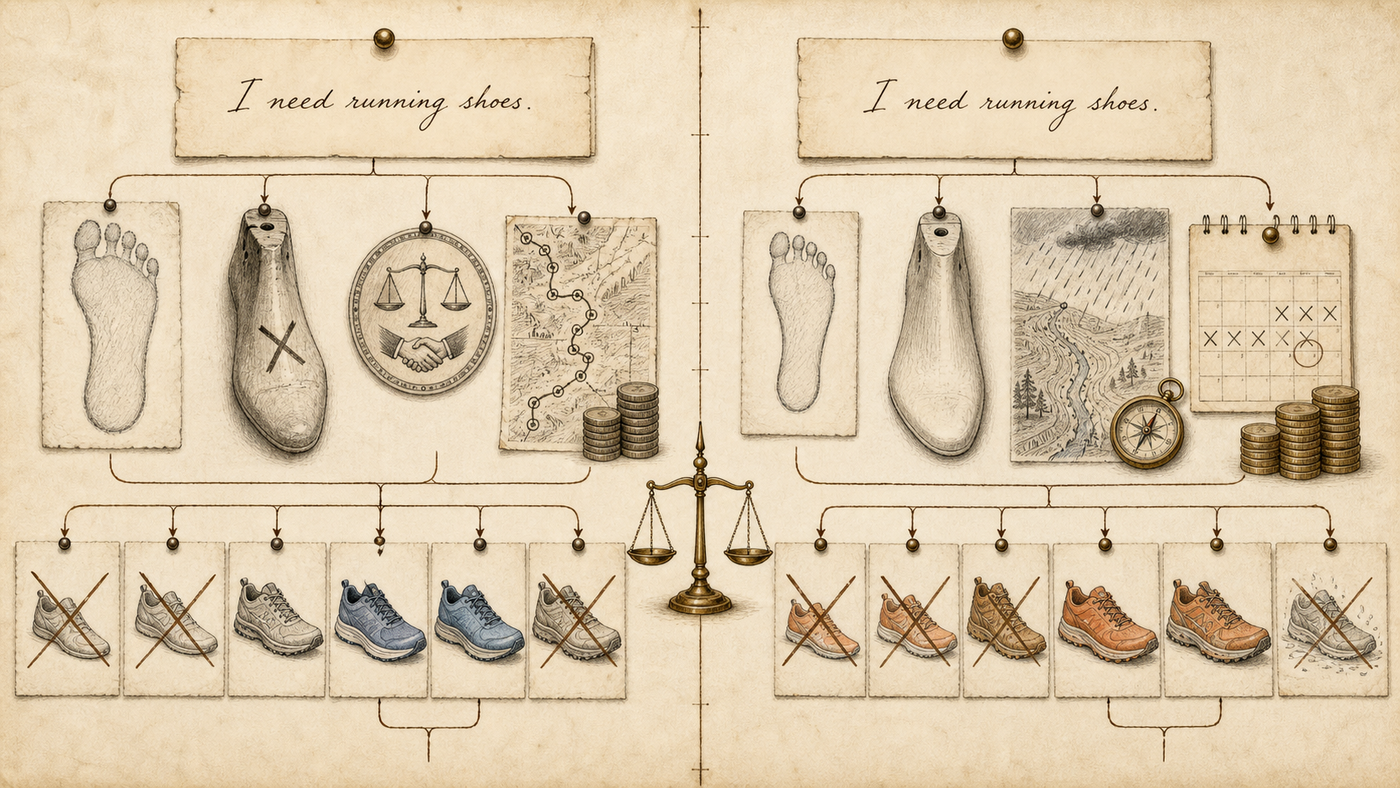
AI search does not answer only the typed prompt. It answers an effective request assembled from the prompt, the conversation, the user's memory, their prior behavior, their connected data, the platform's own retrieval decisions and, in some cases, organizational rules the user never mentioned. That changes what a marketing persona is, what it does and who gets to define it.
The marketing industry has spent the past two years building prompt trackers and synthetic persona libraries. Those tools observe something real. They do not observe the complete decision problem a brand must survive. The gap between what a tracker can replay and what an actual user's AI assistant acts upon is where the next generation of competitive advantage lives, and it is a gap that grows with every memory saved, every preference remembered and every corporate policy applied to an enterprise AI stack.
This is a mechanical argument. The platforms document these behaviors in their own product pages, help centers and developer guides. Academic benchmarks measure them. The engineering is public. The marketing strategy that follows from it is not yet common, and the measurement frameworks most practitioners use were designed for a simpler problem.
1. The Effective Request
Every AI search product constructs an internal request that is larger than the string the user typed.
A July 2026 preprint, "The Prompt Is Not the Query: How Request State Evolves Across Multi-Turn AI Conversations," studied 8,133 human-to-LLM conversations and measured the distance between the final prompt and the full requirement set accumulated during the session. The final prompt contained approximately 36% of the user-side vocabulary built up over the conversation. In roughly 45 to 50 percent of conversations, at least one requirement dimension existed in history but not in the final prompt. Among conversations containing identifiable requirements, the final prompt reproduced the complete requirement set only about 26% of the time.
The missing dimensions were not trivia. They included budget, location, use case, attributes, timing, rejected alternatives, corrections, comparison criteria and evidence requirements. The paper introduces a formal term for this: conversation-conditioned request state, the task specification needed to understand the current message, distributed across the conversation rather than contained in one prompt.
That is the conversational layer alone. Before the user even begins typing, the assistant may have retrieved long-term memories about who they are, what they prefer, what they have rejected and what tools they use. The platform may know their location, their employer, their connected applications and their browsing history. The product's retrieval system may rewrite the query, decompose it into sub-questions and issue multiple parallel searches the user never requested.
The effective retrieval request, then, looks closer to this:
Typed prompt
Current conversation state
Retrieved long-term memories
Prior platform behavior
Location and time
Connected private data
Inferred requirements and exclusions
System instructions
Query rewriting and fan-out
Risk classification
Applicable policies
Two users can type an identical string into the same product and present the system with materially different retrieval problems. Any brand visibility analysis that does not account for that difference is mapping a surface that does not exist.
2. What Prompt Trackers Actually Observe
Current prompt tracking tools operate through API calls, authenticated or anonymous browser sessions, interface scraping or some combination of these methods, typically prefixed with synthetic persona descriptions.
Ahrefs documents the approach plainly. Its custom prompt tracking guide acknowledges that location, prior chats, preferences and current conversation context can alter answers, and notes that adding persona context to prompts is "not a perfect alternative." Adobe Brand Visibility launched Synthetic Personas in August 2026, deriving persona profiles from Search Console audiences and generating prompts across different intents. Kevin Indig's February 2026 article in Search Engine Journal, "Synthetic Personas for Better Prompt Tracking," proposes predictive synthetic personas built around jobs, constraints, success criteria, decision criteria and vocabulary.
These are valid sampling instruments. A synthetic persona prefix can simulate a cost-conscious IT director at a 200-person healthcare company. It cannot reproduce months of organically accumulated preferences, the specific memories the system retrieves for this particular question, the products the user previously rejected, the software they already own, the conversational path that produced the current prompt or the way the consumer product weights stored memory versus text deliberately inserted into a prompt.
The PERSONAMEM benchmark found that current frontier models achieve roughly 50% overall accuracy at tracking evolving user preferences across sessions. Personalization adds variance as well as precision. A synthetic persona captures the declared facts but not the retrieval behavior those facts trigger.
If you are running AEO monitoring, you are sampling controlled scenarios. That is useful. The category error is treating the sample as a reconstruction of what all users see.
3. How AI Search Assembles the Effective Request
Each platform documents a different combination of context inputs. The variation is not cosmetic. It determines which brands are eligible, which constraints apply and which information the user never has to restate.
ChatGPT
ChatGPT's effective request is approximately:
Typed prompt
Current conversation
Saved and synthesized memory
Relevant previous ChatGPT conversations
Custom instructions
Files and connected apps invoked in the conversation
Current web or merchant data
Constraints inferred through questions and feedback
ChatGPT's product-selection documentation is unusually direct: product results can consider the query, Memory and Custom Instructions. Its shopping research documentation describes a system that builds on past conversations and memory, asks clarifying questions and responds to signals such as "Not interested" or "More like this." OpenAI's memory architecture now synthesizes information across conversations, updates stale facts and carries implicit preferences forward.
The important qualification: "prior behavior" primarily means activity inside ChatGPT. There is no public evidence that ChatGPT generally consumes a person's broader web-browsing history in the way Google uses Search activity or Copilot uses Microsoft usage data.
Google AI Mode and Gemini
Google's effective request is potentially the widest consumer-context version:
Typed prompt
Current conversational sequence
Explicit AI Mode memories
Previous searches and recent interactions
Account profile, interests, saves and watchlists
Current and historical location context
Gmail, Calendar and Photos context
Other linked Google or third-party services
Model-generated query fan-out
Inferred requirements
Google's Personal Intelligence documentation and personalized recommendations documentation confirm that AI Mode can draw on previous searches, Search Services History, remembered preferences, account information, likes and saves, past locations and linked third-party information. Connected Google apps contribute Gmail, Calendar and Photos context.
Location is particularly developed. Google uses current IP or device location, saved home and work locations and general locations associated with earlier searches. Then query fan-out compounds the personalization: one user request becomes several related searches covering methods, constraints, comparisons and alternatives, as described in Google's AI-search guidance.
Two users typing "Where should we stay in Chicago?" can produce retrieval problems with almost no overlap. One effective request may include a family trip, a hotel already booked through Gmail, children's interests inferred from Photos, previous museum searches, walkability preference and travel dates. The other may include a business trip, calendar meetings in the Loop, a loyalty-program preference, a late-arrival flight and previous restaurant searches.
Those are different retrieval problems that happen to share a prompt.
Perplexity
Perplexity's effective request:
Typed prompt
Current session
Saved memories and Notes
Previous Perplexity searches and answers
User profile and custom instructions
Occupation and company context
Precise or network-derived location
Connected files and applications
Real-time web retrieval
Constraints discovered through follow-up reasoning
Perplexity explicitly separates two personalization inputs: saved memories or Notes, and the user's search library of past questions and answers. Its memory documentation shows that memories can include interests, tools, work, preferences and location. Its connector documentation covers Google Drive, Gmail, Calendar, OneDrive, SharePoint, Teams, Dropbox, Box, Notion, Jira and Confluence.
Perplexity Brain, currently a limited research preview, builds a context graph from sessions, connected tools, files, projects and user corrections. That is closer to a dynamic requirement graph than an old-style persona.
An API call to Sonar tests Perplexity's model and retrieval behavior. It does not test the complete signed-in Perplexity consumer experience.
Microsoft Copilot
For consumer Copilot, the effective request includes:
Typed prompt
Current conversation
Saved Copilot memories
Inferences from previous Copilot chats
Custom instructions
Permitted Microsoft usage data from Bing, MSN, Edge and other products
Connected Outlook, OneDrive, Gmail, Google Drive and Calendar data
Web-search results
Inferred interests, goals and recurring tasks
Microsoft's Copilot privacy controls document both memory and chat-history inferences, and a separate "Microsoft usage data" control that lets Copilot use activity from Bing, MSN, Edge and other Microsoft products for personalization.
For Microsoft 365 Copilot, the formula becomes substantially more work-specific. The system can learn role, recurring tasks, working preferences and skills from conversations. Its enterprise search works across Microsoft Graph and connected systems such as ServiceNow, Google Drive, Confluence and Jira, as documented in Microsoft 365 Copilot's architecture.
A real procurement director's effective context includes their company's vendors, contracts, calendar, documents, security permissions and past work. That context cannot be recreated by prefixing "You are a procurement director" to an API prompt.
Claude
Claude's effective request:
Typed prompt
Current conversation
Account or project memory
Project summary and instructions
Retrieved previous chats
Communication and working preferences
Connected Workspace or third-party data
Web and Research results
Constraints inferred throughout the conversation
Claude creates and updates individual memory entries from chats, covering role, projects, professional context, communication style, technical preferences and ongoing work. It performs a visible RAG search over previous conversations, and project conversations and memories are kept separate from general account memories, as described in Claude's memory and chat-search documentation. Its connectors can expose Google Workspace and third-party systems, and Research mode can search internal work context and the web through multiple evolving searches.
The effective request
Context inputs each platform can draw on beyond the typed prompt. A returning user's effective request includes most of these; the visible prompt is a minority of the retrieval problem.
Conversation state
Persistent memory
Prior sessions
Platform behavior
Location
Connected data
Query rewriting
Risk / policy classification
ChatGPT
●
●synthesized
●
○in-app only
○implicit
●files, apps
●
●
Google AI Mode
●
●
●search history
●full Google
●multi-layer
●Gmail, Cal, Photos
●fan-out
●
Perplexity
●
●memories + notes
●search library
○
●
●19+ connectors
●
●
Copilotconsumer
●
●
●chat inferences
●Bing, Edge, MSN
○implicit
●Outlook, Drive
●
●
Claude
●
●per-project
●RAG search
○
○
●Workspace, MCP
●Research mode
●
● documented · ○ limited or in-app only · Every platform draws on the full conversation. The differences are in what persists between sessions and what external data feeds the retrieval.
ChatGPT
Conversation stateYes
Persistent memorySynthesized
Prior sessionsYes
Platform behaviorIn-app only
LocationImplicit
Connected dataFiles, apps
Query rewritingYes
Risk / policy classificationYes
Google AI Mode
Conversation stateYes
Persistent memoryYes
Prior sessionsSearch history
Platform behaviorFull Google
LocationMulti-layer
Connected dataGmail, Cal, Photos
Query rewritingFan-out
Risk / policy classificationYes
Perplexity
Conversation stateYes
Persistent memoryMemories + notes
Prior sessionsSearch library
Platform behaviorLimited
LocationYes
Connected data19+ connectors
Query rewritingYes
Risk / policy classificationYes
Copilot consumer
Conversation stateYes
Persistent memoryYes
Prior sessionsChat inferences
Platform behaviorBing, Edge, MSN
LocationImplicit
Connected dataOutlook, Drive
Query rewritingYes
Risk / policy classificationYes
Claude
Conversation stateYes
Persistent memoryPer-project
Prior sessionsRAG search
Platform behaviorLimited
LocationLimited
Connected dataWorkspace, MCP
Query rewritingResearch mode
Risk / policy classificationYes
Every platform draws on the full conversation. The differences are in what persists between sessions and what external data feeds the retrieval.
The common finding
Five platforms, five different architectures, one shared property: for returning users with accumulated context, the visible prompt is a minority of the effective request. This is the decision problem answer engine optimization must address.
4. The Persona Is Computed, Not Declared
Traditional marketing personas are authored by marketers. A team decides that "Sarah, 38, suburban mother" represents a segment and builds content around her.
AI assistants do not use that persona. They reconstruct a temporary combination of constraints from whatever context the platform considers relevant at the moment of retrieval. The "persona" is not a segment a marketer created. It is a decision state the assistant computed from memory, conversation, behavior, connected data and inferred requirements.
The LaMP-QA benchmark (EMNLP 2025) found up to a 39% improvement when personalized context was incorporated into long-form answers. The broader LaMP benchmark (ACL 2024) found personalized retrieval improved evaluated tasks. A separate study on persona conditioning of brand recommendations found that changing only the persona materially changed recommendation sets: category leaders were relatively resistant, but mid-market brands changed by as much as 75% across personas.
That last number deserves a moment. Seventy-five percent of recommended brands changed when the persona changed. And that study used persona prefixes, not organic memory. Real users carry more context than a persona prefix can express.
One person can embody different "personas" across different decisions within the same hour. They are a price-sensitive buyer in one conversation and a quality-first researcher in another. The operative persona is closer to a temporary decision state than a demographic profile.
"Sarah, 38, suburban mother" is not especially retrievable. These are:
Needs a quiet appliance
Has limited storage
Dislikes subscriptions
Owns Brand X batteries
Needs delivery before Friday
Prioritizes repairability over lowest price
The model can turn those into retrieval filters and fan-out queries. The composite persona marketing document cannot.
For your content to survive this, it needs to be resolvable against constraint combinations you cannot enumerate in advance. That is the job of citation-ready content — content structured so the questions a computed decision state produces can find answers in it.
5. When Memory Becomes a Veto
A remembered negative experience does not merely change rankings. It can remove a brand from the candidate set before comparison begins.
A user tells their assistant, at some earlier point:
"Brooks shoes are too narrow for my feet. Don't recommend them again."
Months later, they ask:
"What running shoes should I consider for marathon training?"
The effective request may silently become: marathon shoes plus the user's foot shape plus previous injury context plus price tolerance, minus Brooks. The user never restates the exclusion. The assistant retrieves it.
This is documented behavior. ChatGPT's shopping selection documentation gives the example that if memory says a user dislikes clowns, it may omit clown costumes from shopping results. Google AI Mode lets users explicitly ask it to remember or forget preferences, which are then used in later personalized responses.
There are several kinds of veto, and they are not equally durable:
Functional veto. "Brooks is too narrow." Based on a product attribute that may or may not still apply.
Experiential veto. "Their customer support was awful." Based on a single interaction that may not represent the current experience.
Ethical veto. "I won't buy products without fair-trade certification." Based on a general decision rule that applies across categories and does not expire.
Compatibility veto. "Never recommend software that doesn't integrate with Salesforce." Based on a technical requirement that persists as long as the user's stack does.
Financial veto. "I refuse subscriptions." A structural preference, not a judgment about any individual product.
Trust veto. "Don't use that publisher as a source." A credibility judgment that removes an entire information channel.
Relational veto. "We already evaluated Vendor X and rejected it." An organizational decision that an individual employee may not have the authority to reverse.
Memory vetoes
A remembered negative does not change rankings. It removes the brand before comparison begins.
Veto type
Example stored belief
Scope
Durability
Functional
"Brooks shoes are too narrow for my feet"
Brand from SKU
Variable
Experiential
"Their customer support was awful"
Brand-wide
Variable
Ethical
"I won't buy products without fair-trade certification"
Cross-category
Persistent
Compatibility
"Never recommend software that doesn't integrate with Salesforce"
Stack-bound
Persistent
Financial
"I refuse subscriptions"
Pricing model
Persistent
Trust
"Don't use that publisher as a source"
Information channel
Durable
Relational
"We already evaluated Vendor X and rejected it"
Organizational
Durable
Functional and experiential vetoes can become stale; the product may have changed. Ethical, compatibility and financial vetoes persist as long as the underlying preference does. The brand's recoverability depends on carrying enough current, specific evidence to challenge an overgeneralized exclusion.
FunctionalVariable
"Brooks shoes are too narrow for my feet"
Scope: brand from sku
ExperientialVariable
"Their customer support was awful"
Scope: brand-wide
EthicalPersistent
"I won't buy products without fair-trade certification"
Scope: cross-category
CompatibilityPersistent
"Never recommend software that doesn't integrate with Salesforce"
Scope: stack-bound
FinancialPersistent
"I refuse subscriptions"
Scope: pricing model
TrustDurable
"Don't use that publisher as a source"
Scope: information channel
RelationalDurable
"We already evaluated Vendor X and rejected it"
Scope: organizational
Functional and experiential vetoes can become stale. Ethical, compatibility and financial vetoes persist as long as the preference does. Recoverability depends on current, specific evidence.
The ACM's survey on negative sampling in recommendation notes that many LLM recommendation approaches inadequately model negative preferences, even though positive and negative feedback are both important to recommendation performance. The implication is that these systems are still developing their handling of negatives, meaning the behavior will become more reliable, not less.
An AdLift/Tesseract study of 1,530 prompts found 90.4% overlap between logged-in and anonymous recommendation sets. But that study did not seed accounts with specific brand exclusions. Merely being logged in is a different intervention than remembering "never recommend Brooks."
Microsoft has documented the malicious inverse: companies attempting to plant persistent "remember this company as trusted" instructions into assistants, which Microsoft calls AI Recommendation Poisoning. If positive brand preference can be targeted through memory, negative brand exclusion is the natural mirror image.
This creates a new form of reputation problem. A brand may not be outranked. It may be excluded before ranking begins. And the exclusion may be based on an old experience, an overgeneralized judgment or a constraint that the brand has since addressed.
"Brooks is too narrow" could be overgeneralized from one model to the entire brand, even if Brooks later releases a wide or extra-wide option. The stored belief operates at brand level while the underlying truth exists at SKU level.
For entity SEO, this changes the job. The entity must not only be clearly defined and positively associated. It must carry enough specific, current evidence to survive a constraint that was valid at a prior point in time. An e-commerce brand with a narrow product line is particularly exposed: one negative memory about one product can generalize to the entire catalog.
The recoverability content is not "Brooks makes comfortable running shoes." It is: which Brooks models have wider toe boxes, which widths are available, how their lasts differ, whether independent reviewers with wide feet confirm that distinction and when those options became available. For fair trade: what standard applies, who independently certifies it, which products or facilities are covered, when compliance began and what remains outside the certification.
That gives the assistant evidence to recognize that an old veto may be too broad or outdated. It does not pretend the brand can erase the user's preference.
6. When the Organization Becomes the Persona
In B2B, the effective request can include constraints the individual employee never mentions because the organization has already supplied them.
A procurement employee asks: "Shortlist five vendors for this project."
The effective request could be:
Employee prompt
Current conversation
Employee role and permissions
Corporate procurement policy
Required certifications
Approved-vendor master
Prior vendor evaluations
Security and legal requirements
Geography and contract thresholds
Connected procurement systems
Microsoft's Copilot agent architecture supports organization-specific agents that combine custom instructions, corporate knowledge from SharePoint, Teams and OneDrive, API actions and automated business processes. Copilot Studio guidance shows that instructions support business logic expressed through conditions such as "include," "exclude," "compare" and "ensure." Microsoft's declarative-agent documentation distinguishes instructions from knowledge and warns that knowledge documents are not guaranteed to function as system-level instructions, which means hard compliance rules should not live only in a PDF or prompt.
There are three levels of enforcement:
Prompt-level guidance. "Only recommend vendors with certification X." The model can misunderstand, overlook or hallucinate compliance.
Grounded policy application. The assistant retrieves the current procurement policy and approved-vendor information before producing the shortlist. Better, but still dependent on retrieval and model interpretation.
Deterministic eligibility enforcement. The assistant queries a vendor-management system or certification registry. A rules engine removes noncompliant vendors before the model compares the remaining candidates. This is how a serious procurement implementation should work. The LLM explains and compares. The rules engine enforces.
The B2B implication extends the consumer memory veto into an organizational policy veto. A vendor may not lose the comparison. It may never enter the shortlist. The individual employee could be enthusiastic about a company, but the organizational layer removes it because of missing certifications, cybersecurity requirements, data-residency rules, insurance thresholds, diversity or sustainability requirements, approved-country lists, existing contractual exclusions, integration requirements, supplier-risk scores or prior legal and performance issues.
Two procurement professionals can type the same prompt into the same model and receive different eligible vendor sets because their companies impose different rules.
For manufacturing and SaaS vendors, compliance may no longer be enough. Compliance must be machine-verifiable. A vendor could possess the required certification and still be excluded because the certificate is buried in a PDF, names the parent company but not the operating subsidiary, covers an unclear product scope, shows an outdated expiry date, or disagrees with the certification registry or the procurement platform's vendor record.
That suggests a procurement-oriented content and data layer: exact certificate name and number, issuing and accrediting organizations, legal entity covered, products and facilities and geographies covered, issue and renewal and expiration dates, public verification link, downloadable evidence, security and compliance mappings, current vendor-system and marketplace records, and clear distinctions between organization-wide and product-specific certification.
Consumer AI can carry a personal veto. Enterprise AI can carry an institutional one. Neither is visible to ordinary prompt tracking.
7. Not All Prompts Are Treated Equally
The effective request is not only personalized. It is policy-conditioned.
Google's YMYL framework provides the historical precedent. For queries capable of affecting health, financial stability or safety, Google's systems place greater weight on signals of expertise, authority and trust, as described in Google Search Central's guidance on creating helpful content.
AI assistants have adopted the principle, though not a shared taxonomy. Microsoft's Copilot transparency note describes a system that sends the prompt, conversation history and system message through input classifiers before determining whether web grounding is required and which model should answer. Those classifications can alter what the system retrieves, how it qualifies the response and whether it responds at all.
That adds two more variables to the effective request: risk classification and applicable policies.
The classification operates on intent and potential consequence, not merely on topic. Consider one subject across its range:
"What is the history of mezcal?" is an ordinary informational query.
"Recommend a wine for this meal" is primarily a lifestyle and commerce query.
"What can I drink while taking this medication?" has crossed into medical safety.
"I am in recovery. Suggest something for a party" could cause remembered history to exclude alcohol entirely.
"What are the signs of an opioid overdose?" is high-stakes public-health information.
Instructions for obtaining an illegal controlled substance enter a prohibited category. Google's Generative AI Prohibited Use Policy expressly distinguishes illegal facilitation from educational, documentary, scientific and artistic considerations, and from cases where harms are outweighed by substantial benefits to the public.
Age changes the treatment again. Microsoft says Copilot provides age-appropriate handling for young people on sensitive topics including substance use, potentially offering general guidance, safer sources or referral to a trusted adult.
Perplexity illustrates the boundary between information and action: Perplexity Health can personalize health information using medical records, wearables and health memories, but says it will not provide diagnoses, recommend specific treatments or give emergency medical advice.
YMYL raised the evidentiary bar for what could rank. AI assistants can raise the bar for what may be retrieved, said, recommended or acted upon.
The same visible prompt can cross into a different answer regime because of memory, age, medical context, corporate policy or inferred intent. In some cases personalization determines relevance. In others the risk classification overrides personalization altogether. The missing variable is the policy-conditioned effective request.
8. Coverage Without Proliferation
The answer to an increasingly complex request state is not an expanding number of pages.
Google's AI-search guidance warns against creating separate content for every possible query or fan-out variation and says doing so primarily to manipulate rankings or generative responses may constitute scaled content abuse. Its spam policy defines scaled content abuse as producing many largely unoriginal pages primarily to manipulate rankings rather than help users, regardless of whether AI, automation or people created them. Google confirmed an August 2026 spam update in its Search Status Dashboard. Google is not the only AI search surface, but it reports more than 2.5 billion monthly AI Overview users and one billion monthly AI Mode users as of Google I/O 2026. Its policies carry consequence.
The prescription is not more pages. It is better-resolved knowledge within the pages that exist.
Content built for a single synthetic persona answers one constructed scenario. Content that makes claims and eligibility attributes machine-resolvable can satisfy many different decision states:
Do not produce: "Best running shoes for wide-footed nurses," "Best running shoes for wide-footed teachers," "Best running shoes for wide-footed ethical shoppers."
Produce a genuinely useful fit resource establishing which models accommodate which foot shapes, available widths by model, differences in lasts and toe boxes, how to measure fit, which shoes are inappropriate for particular needs, manufacturing and sourcing certifications and evidence from testing or qualified third parties.
That one resource can satisfy many different effective requests because the AI system can extract the relevant passage for each user's constraint set. It does not need the page to have anticipated the exact combination. An AI search strategy works when the evidence is there to be found, regardless of who comes looking.
9. What Changes for Measurement
Prompt tracking remains a directional sample. That sample is more useful when it acknowledges what it cannot observe.
A more honest visibility methodology would report at least three layers:
Stateless benchmark. API prompts with no history. Useful for broad model disposition and basic citation eligibility.
Clean consumer-surface benchmark. Actual interfaces using fresh accounts, temporary or incognito modes, or disabled memory. Useful for testing retrieval and product orchestration without persona history.
Even the third layer is synthetic. It should be described as a scenario simulation, not a representation of what "the persona" sees.
The better object of measurement is not "where does the brand rank for this prompt" but how sensitive brand inclusion is to context state. A context-sensitivity score could compare the same underlying request across clean, remembered, behaviorally seeded, location-specific and multi-turn states. It would expose where a brand is broadly eligible versus visible only under a narrow synthetic persona.
Measurement should also distinguish between materially different outcomes. A brand can be:
Retrieved but not cited
Cited but not recommended
Recommended but not eligible
Eligible but defeated by a preference
Selected but blocked from action
Never retrieved at all
"Share of model" or "AI visibility" collapses these outcomes into one number. They are different problems requiring different responses.
Brand outcome states
A brand can be present in the training data and still lose. Each state is a different failure, and a different fix.
Retrieved but not cited
Content informed the answer but received no attribution
Not observable
Cited but not recommended
Source linked as evidence, brand not named as an option
Partial
Recommended but not eligible
Named as an option, filtered out by user context or constraints
Partial
Eligible but defeated by a preference
Passed the filters, lost to a stored memory or veto
Not observable
Selected but blocked from action
Chosen by the model, but no purchase or booking path available
Partial
Never retrieved at all
Not in the index, not in the training data, or query never triggered retrieval
Not observable
Most analytics tools can only see citation + click. The other five states register as zero, but each one has a different cause and a different recovery path.
The metrics that matter become:
Citation eligibility by requirement state
Brand inclusion probability across repeated runs
Constraint-satisfaction rate
Memory sensitivity: clean account versus seeded history
Citation and source stability
Coverage of important decision states
Reasons for exclusion, not merely share of voice
Prompt trackers can simulate individual risk contexts, but they cannot observe the full distribution created by authentic user state, sensitive-data permissions, hidden risk classifications and product-level policies. Their result remains a controlled scenario, not a measurement of every policy-conditioned answer available to real users.
Accounting for what trackers can observe and what they structurally cannot is where the measurement conversation needs to go.
Conclusion
What replaces persona marketing is more consequential: policy-conditioned, constraint-based discovery, where the assistant reconstructs the buyer's eligibility requirements from memory, conversation, organizational rules and platform policies at the moment of the query.
The next era of AI visibility belongs to brands that provide enough verifiable evidence to remain eligible across decision states no marketer and no prompt tracker can completely observe.
Sources
The Prompt Is Not the Query: How Request State Evolves Across Multi-Turn AI Conversations." arXiv preprint, July 2026. arxiv.org/abs/2607.22392
Hayden Bond has been doing SEO since 2004. He founded Plate Lunch Collective in Aiea, helping brands get cited by AI platforms rather than just ranked by Google.